
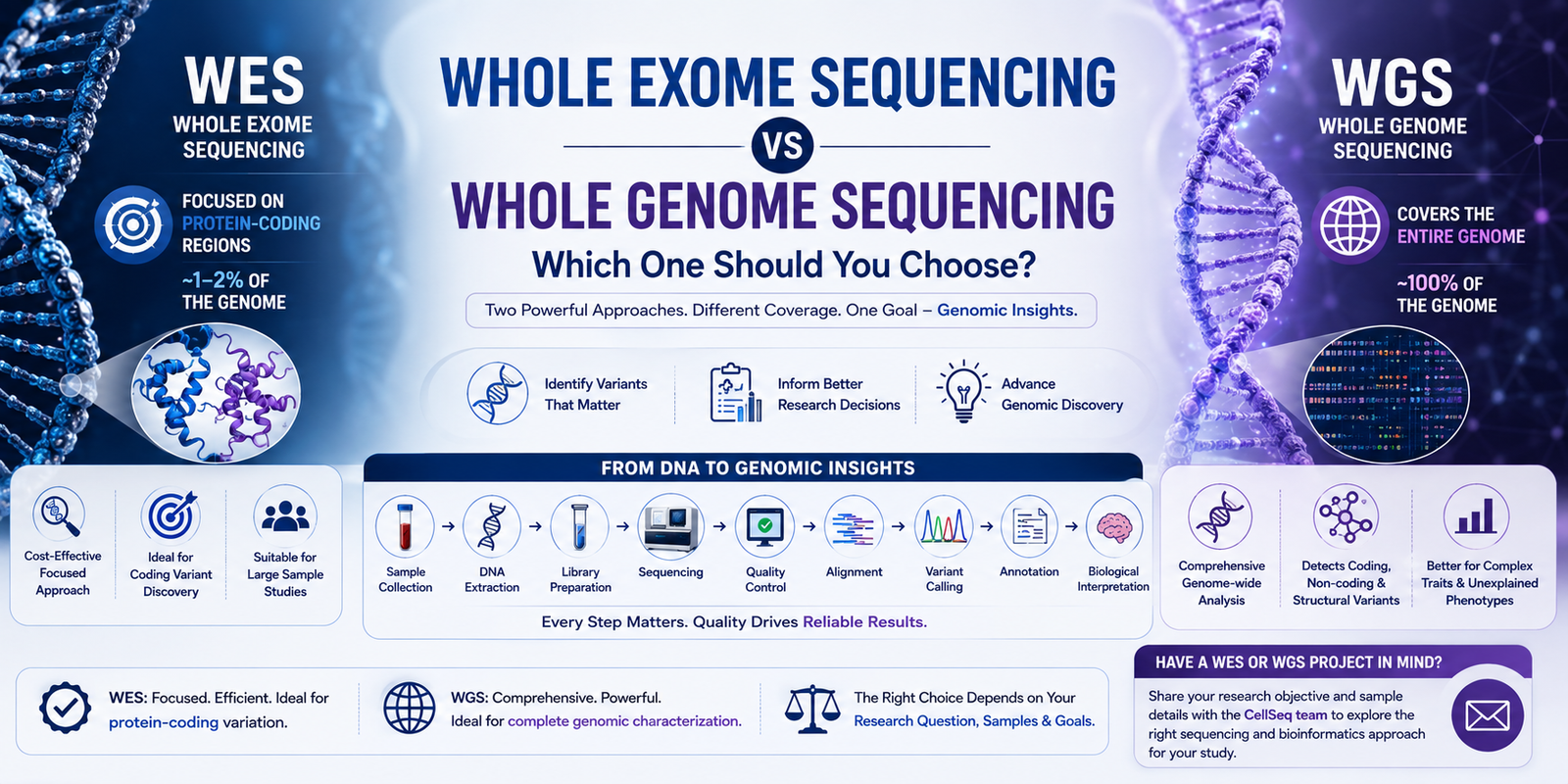

Whole Exome Sequencing (WES) and Whole Genome Sequencing (WGS) are powerful next-generation sequencing approaches used to investigate genetic variation. While both technologies can identify important genomic variants, they differ in genomic coverage, variant detection, data requirements, and cost.
So, which one is right for your research?
The answer depends on the biological question you want to answer.
Whole Exome Sequencing (WES)
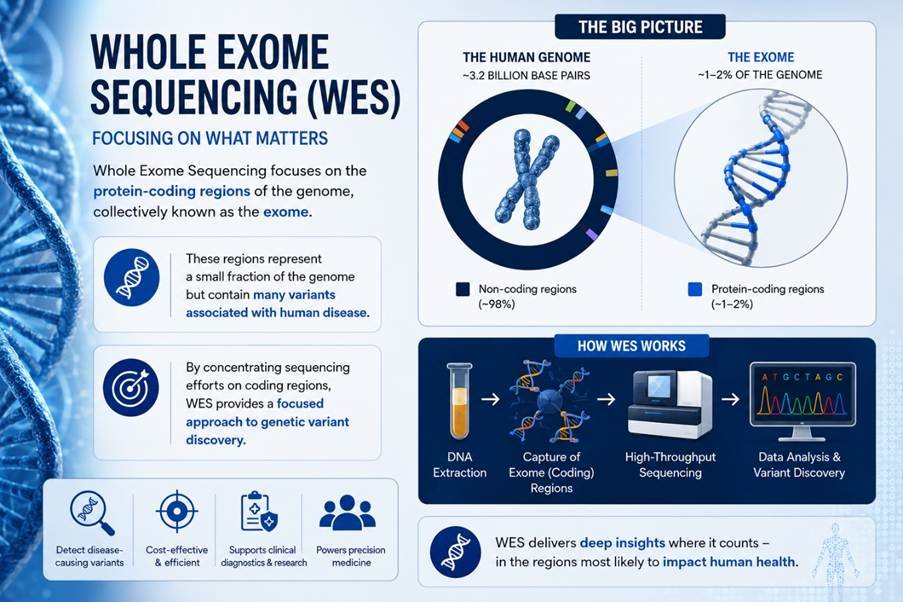
Whole Exome Sequencing focuses on the protein-coding regions of the genome, collectively known as the exome. These regions represent a small fraction of the genome but contain many variants associated with human disease. By concentrating sequencing efforts on coding regions, WES provides a focused approach to genetic variant discovery.
Common applications of WES
- Rare and inherited disease research
- Mendelian disorder studies
- Cancer genomics
- Family-based genetic studies
- Identification of coding SNPs and small indels
- Discovery of potentially disease-associated variants
WES is particularly suitable when your research primarily focuses on protein-coding variation.
Whole Genome Sequencing (WGS)
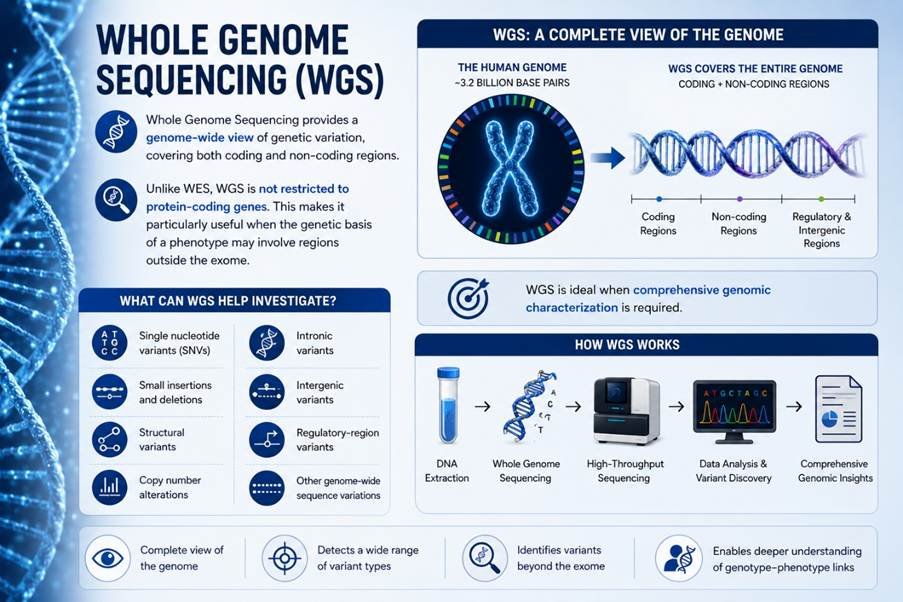
Whole Genome Sequencing provides a genome-wide view of genetic variation, covering both coding and non-coding regions. Unlike WES, WGS is not restricted to protein-coding genes. This makes it particularly useful when the genetic basis of a phenotype may involve regions outside the exome.
What can WGS help investigate?
- Single nucleotide variants (SNVs)
- Small insertions and deletions
- Structural variants
- Copy number alterations
- Intronic variants
- Intergenic variants
- Regulatory-region variants
- Other genome-wide sequence variations
WGS is ideal when comprehensive genomic characterization is required.
WES vs WGS: Key Differences
| Feature | WES | WGS |
| Primary coverage | Protein-coding regions | Genome-wide |
| Coding variants | Excellent | Excellent |
| Non-coding variants | Limited | Broadly assessed |
| SNVs & small indels | ✓ | ✓ |
| Structural variants | More limited | Better suited |
| Data generated | Lower | Higher |
| Computational requirements | Moderate | Higher |
| Relative cost | Generally lower | Generally higher |
| Best suited for | Focused coding analysis | Comprehensive genomic analysis |
WES or WGS: Which One Is Right for Your Project?
A simple way to approach the decision is to start with your research objective.
Choose WES when:
→ You are primarily interested in coding variants
→ Your study focuses on rare or inherited disorders
→ You need a focused sequencing strategy
→ You are analyzing a larger number of samples and data volume is a consideration
Choose WGS when:
→ You need genome-wide variant discovery
→ Non-coding or regulatory variants may be relevant
→ Structural variants are important to your study
→ Previous WES analysis has not explained the phenotype
→ You require a comprehensive genomic dataset
From DNA to Genomic Insights
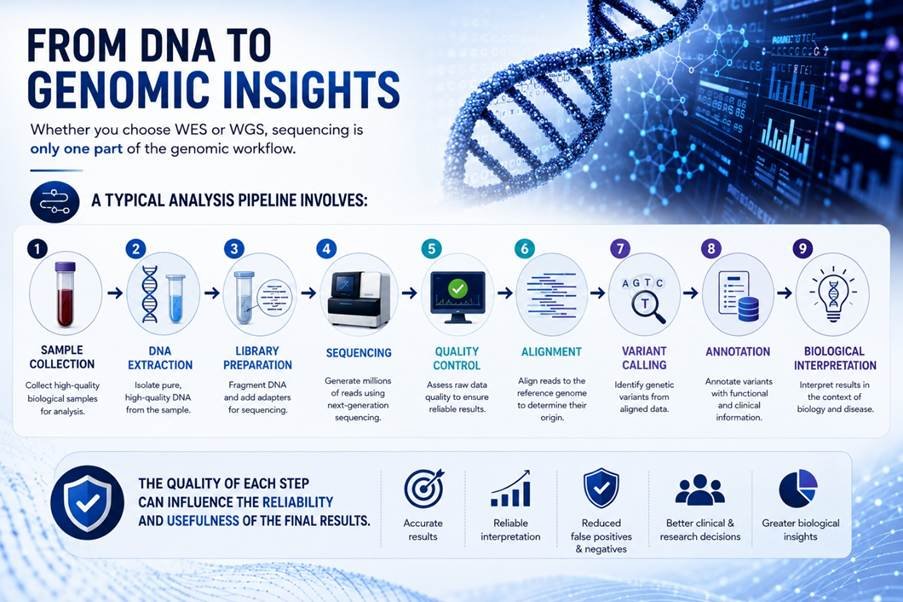
Whether you choose WES or WGS, sequencing is only one part of the genomic workflow.
A typical analysis pipeline involves:
Sample Collection → DNA Extraction → Library Preparation → Sequencing → Quality Control → Alignment → Variant Calling → Annotation → Biological Interpretation
The quality of each step can influence the reliability and usefulness of the final results.
WES vs WGS: The Bottom Line
WES offers a focused and efficient strategy when the primary objective is to investigate protein-coding variation.
WGS provides a much broader view of the genome and is more appropriate when researchers need to investigate coding, non-coding, structural, and other genome-wide variations.
There is no universally superior approach. The right technology depends on your research question, expected variant types, sample cohort, required genomic coverage, and project budget.
Why Choose CellSeq Solutions LLP?
At CellSeq Solutions LLP, we support researchers with genomics and bioinformatics solutions designed around their specific research objectives. From sequencing and quality assessment to variant calling, annotation, and downstream genomic analysis, our workflows can be tailored to the requirements of your study. Whether you are working in rare disease research, cancer genomics, inherited disorders, population genetics, or genomic discovery, our team can help you identify the sequencing strategy that fits your project.
Have a WES or WGS project in mind?
Share your research objective and sample details with the CellSeq team to explore the right sequencing and bioinformatics approach for your study.