

Next-generation sequencing (NGS) has transformed modern genomics by enabling researchers to generate millions of DNA or RNA sequencings reads in a single experiment. However, sequencing is only the beginning. NGS data analysis converts raw sequencing data into meaningful biological information that can support research, disease studies, biomarker discovery, and precision medicine.
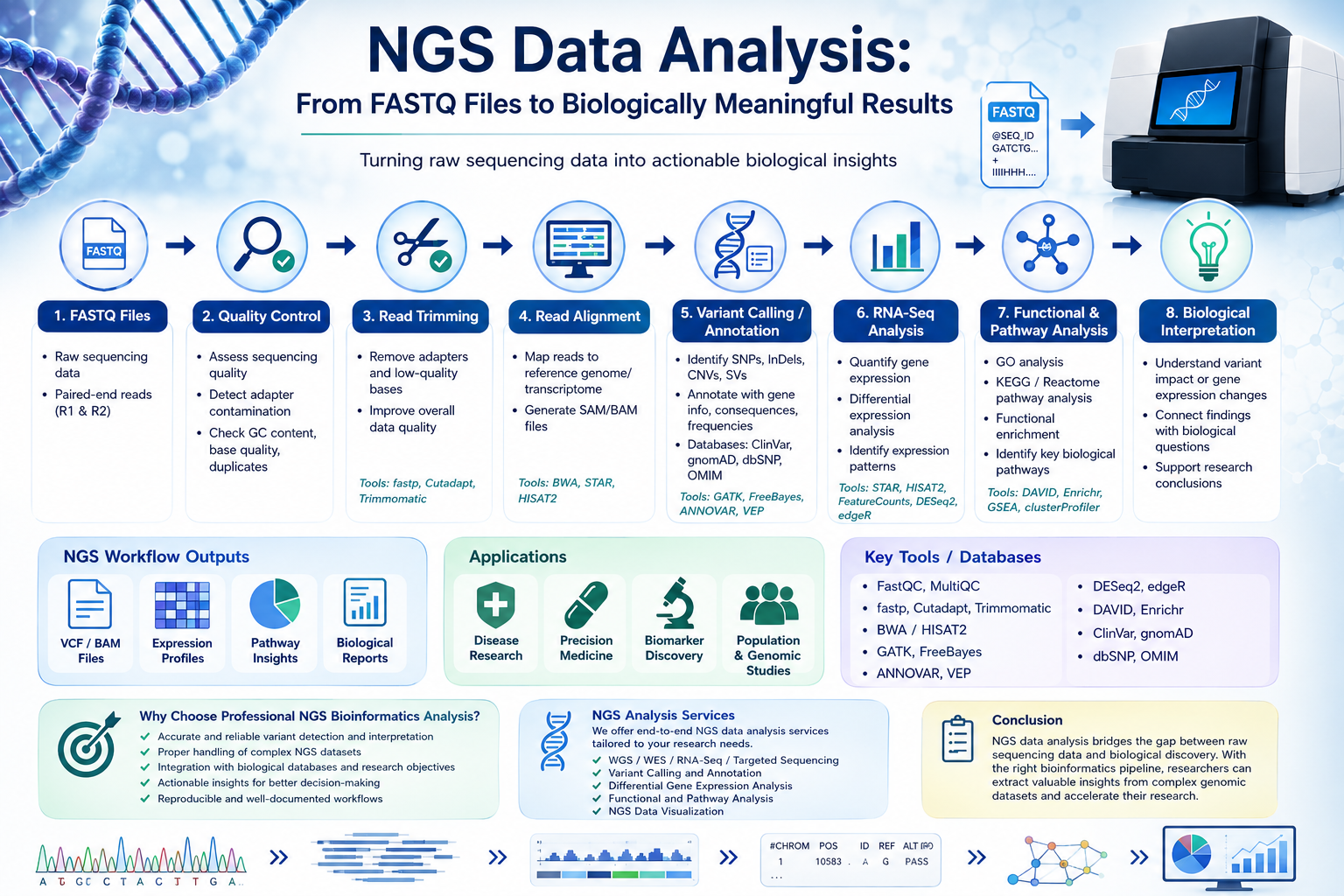
This article explains the major steps involved in NGS bioinformatics analysis, from FASTQ files to biological interpretation.
What Is NGS Data Analysis?
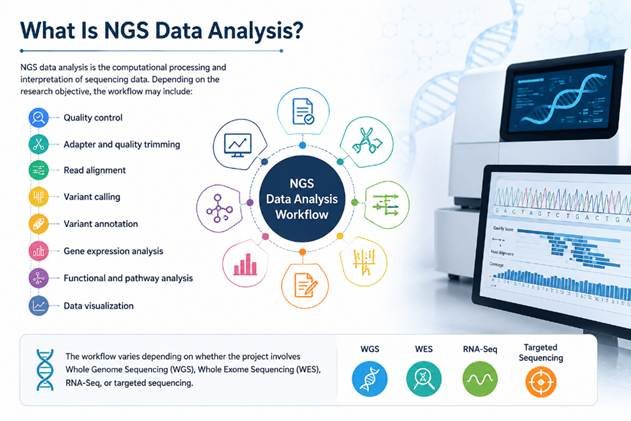
NGS data analysis is the computational processing and interpretation of sequencing data. Depending on the research objective, the workflow may include:
- Quality control
- Adapter and quality trimming
- Read alignment
- Variant calling
- Variant annotation
- Gene expression analysis
- Functional and pathway analysis
- Data visualization
The workflow varies depending on whether the project involves Whole Genome Sequencing (WGS), Whole Exome Sequencing (WES), RNA-Seq, or targeted sequencing.
NGS Data Analysis Workflow
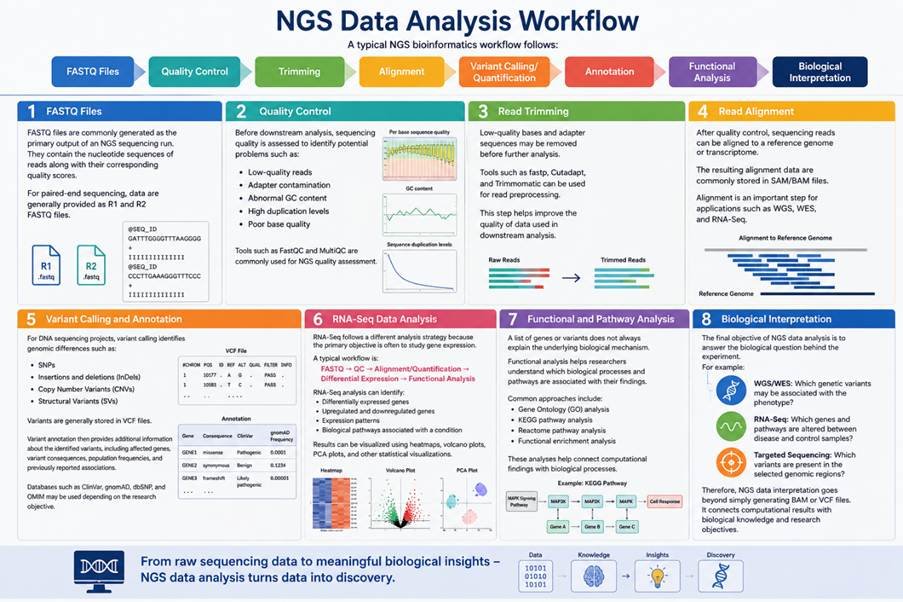
A typical NGS bioinformatics workflow follows:
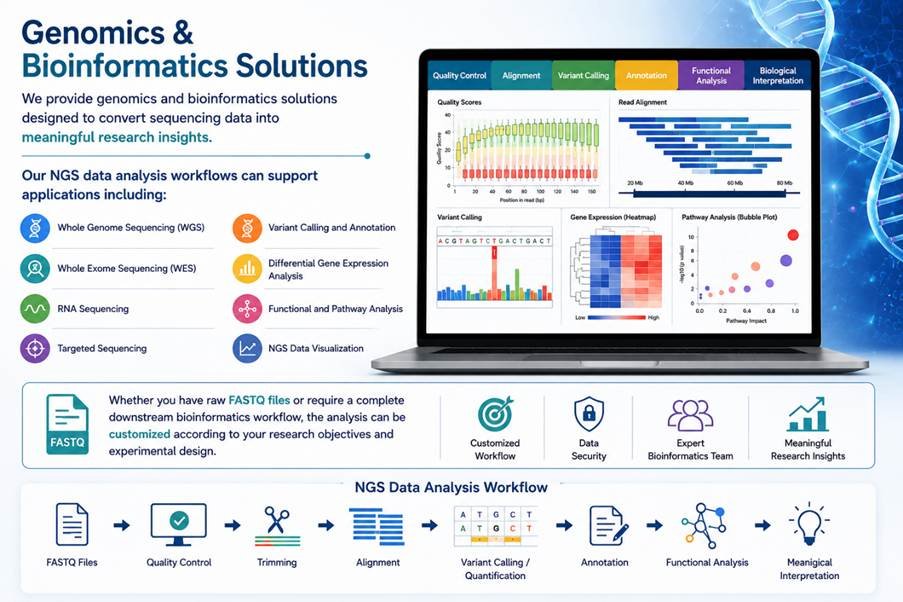
FASTQ Files → Quality Control → Trimming → Alignment → Variant Calling/Quantification → Annotation → Functional Analysis → Biological Interpretation
1. FASTQ Files
FASTQ files are commonly generated as the primary output of an NGS sequencing run. They contain the nucleotide sequences of reads along with their corresponding quality scores.
For paired-end sequencing, data are generally provided as R1 and R2 FASTQ files.
2. Quality Control
Before downstream analysis, sequencing quality is assessed to identify potential problems such as:
- Low-quality reads
- Adapter contamination
- Abnormal GC content
- High duplication levels
- Poor base quality
Tools such as FastQC and MultiQC are commonly used for NGS quality assessment.
3. Read Trimming
Low-quality bases and adapter sequences may be removed before further analysis.
Tools such as fastp, Cutadapt, and Trimmomatic can be used for read preprocessing.
This step helps improve the quality of data used in downstream analysis.
4. Read Alignment
After quality control, sequencing reads can be aligned to a reference genome or transcriptome.
The resulting alignment data are commonly stored in SAM/BAM files.
Alignment is an important step for applications such as WGS, WES, and RNA-Seq.
5. Variant Calling and Annotation
For DNA sequencing projects, variant calling identifies genomic differences such as:
- SNPs
- Insertions and deletions (InDels)
- Copy Number Variants (CNVs)
- Structural Variants (SVs)
Variants are generally stored in VCF files.
Variant annotation then provides additional information about the identified variants, including affected genes, variant consequences, population frequencies, and previously reported associations.
Databases such as ClinVar, gnomAD, dbSNP, and OMIM may be used depending on the research objective.
6. RNA-Seq Data Analysis
RNA-Seq follows a different analysis strategy because the primary objective is often to study gene expression.
A typical workflow is:
FASTQ → QC → Alignment/Quantification → Differential Expression → Functional Analysis
RNA-Seq analysis can identify:
- Differentially expressed genes
- Upregulated and downregulated genes
- Expression patterns
- Biological pathways associated with a condition
Results can be visualized using heatmaps, volcano plots, PCA plots, and other statistical visualizations.
7. Functional and Pathway Analysis
A list of genes or variants does not always explain the underlying biological mechanism.
Functional analysis helps researchers understand which biological processes and pathways are associated with their findings.
Common approaches include:
- Gene Ontology (GO) analysis
- KEGG pathway analysis
- Reactome pathway analysis
- Functional enrichment analysis
These analyses help connect computational findings with biological processes.
8. Biological Interpretation
The final objective of NGS data analysis is to answer the biological question behind the experiment.
For example:
WGS/WES: Which genetic variants may be associated with the phenotype?
RNA-Seq: Which genes and pathways are altered between disease and control samples?
Targeted Sequencing: Which variants are present in the selected genomic regions?
Therefore, NGS data interpretation goes beyond simply generating BAM or VCF files. It connects computational results with biological knowledge and research objectives.
Why Choose Professional NGS Bioinformatics Analysis?
NGS datasets are large and complex, and their interpretation requires appropriate computational pipelines, databases, statistical methods, and biological expertise.
A reliable NGS data analysis workflow should consider:
- Experimental design
- Sequencing quality
- Reference genome
- Appropriate bioinformatics tools
- Variant filtering and annotation
- Statistical analysis
- Reproducibility
- Biological interpretation
NGS Data Analysis Services at CellSeq Solutions LLP
CellSeq Solutions LLP provides genomics and bioinformatics solutions designed to convert sequencing data into meaningful research insights.
Our NGS data analysis workflows can support applications including:
- Whole Genome Sequencing (WGS)
- Whole Exome Sequencing (WES)
- RNA Sequencing
- Targeted Sequencing
- Variant Calling and Annotation
- Differential Gene Expression Analysis
- Functional and Pathway Analysis
- NGS Data Visualization
Whether you have raw FASTQ files or require a complete downstream bioinformatics workflow, the analysis can be customized according to your research objectives and experimental design.
Conclusion
NGS data analysis is the bridge between raw sequencing data and biological discovery.
From FASTQ quality control and alignment to variant calling, gene expression analysis, annotation, and pathway analysis, each step contributes to transforming sequencing data into biologically meaningful results.
With the right NGS bioinformatics pipeline, researchers can extract valuable insights from complex genomic datasets and accelerate their research.