

Introduction
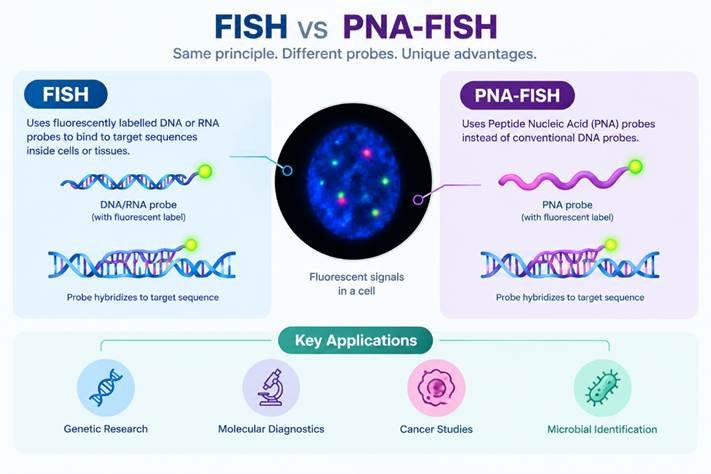
Fluorescence In Situ Hybridization (FISH) is a widely used molecular technique for detecting specific DNA or RNA sequences directly within cells or tissue samples. It uses fluorescently labelled probes that hybridize to complementary nucleic acid sequences.
PNA-FISH (Peptide Nucleic Acid Fluorescence in Situ Hybridization) follows the same basic principle but uses PNA probes instead of conventional DNA probes.
Both techniques are valuable in genetic research, molecular diagnostics, cancer studies, and microbial identification, but their probe chemistry gives them different properties.
What is FISH?
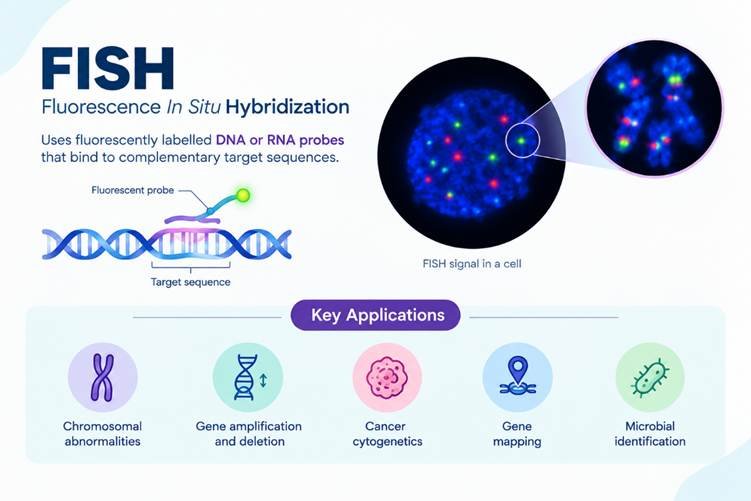
FISH uses fluorescently labelled DNA or RNA probes that bind to complementary target sequences.
Key applications:
- Chromosomal abnormalities
- Gene amplification and deletion
- Cancer cytogenetics
- Gene mapping
- Microbial identification
FISH is particularly useful when researchers need to visualize the location or copy number of specific genetic sequences within cells.
What is PNA-FISH?
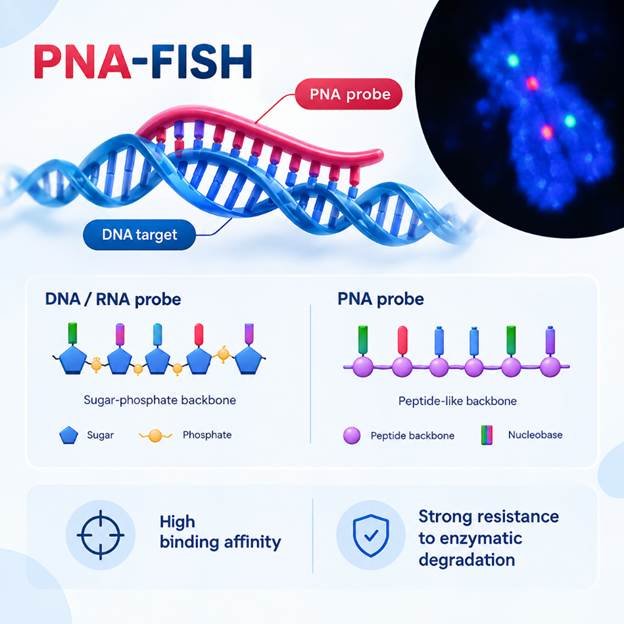
PNA-FISH uses Peptide Nucleic Acid (PNA) probes, in which the conventional sugar-phosphate backbone of DNA is replaced by a peptide-like backbone. This modification provides PNA probes with high binding affinity and strong resistance to enzymatic degradation.
Key applications:
- Rapid microbial identification
- Bacterial detection
- Pathogen screening
- rRNA-targeted microbial analysis
- Clinical microbiology research
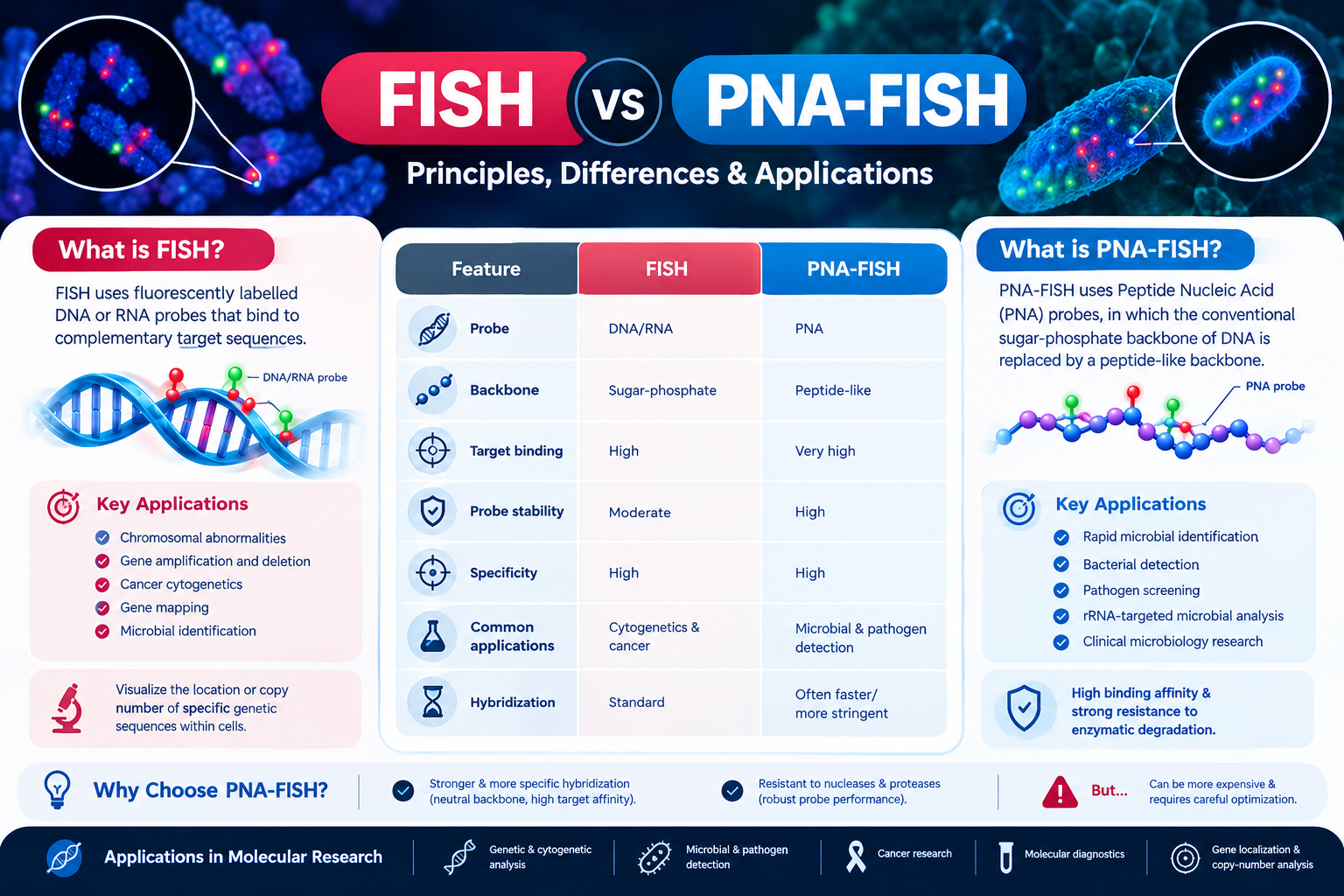
FISH vs PNA-FISH
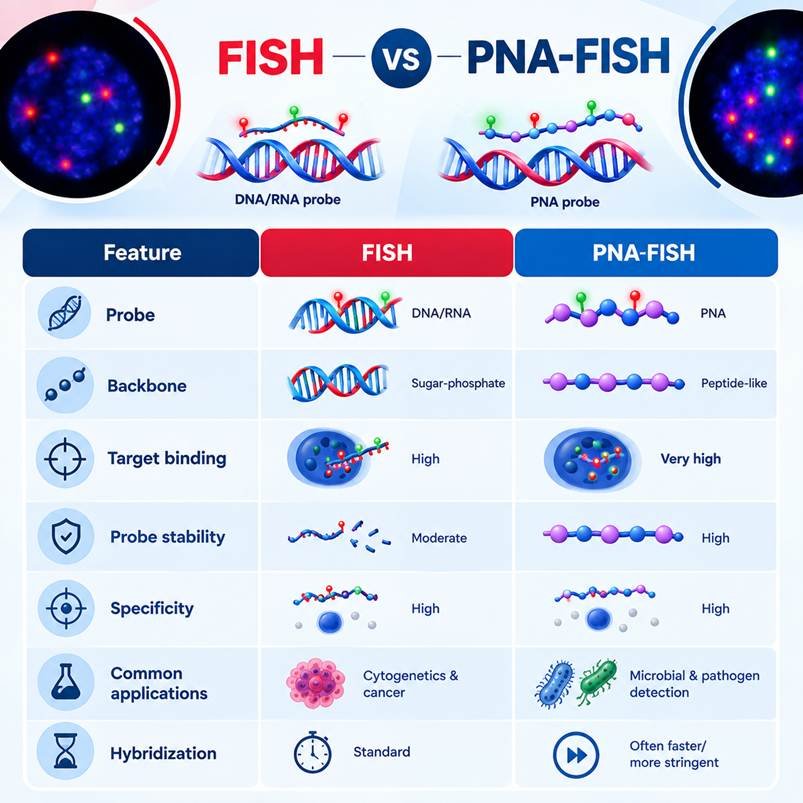
| Feature | FISH | PNA-FISH |
| Probe | DNA/RNA | PNA |
| Backbone | Sugar-phosphate | Peptide-like |
| Target binding | High | Very high |
| Probe stability | Moderate | High |
| Specificity | High | High |
| Common applications | Cytogenetics & cancer | Microbial & pathogen detection |
| Hybridization | Standard | Often faster/more stringent |
Why Choose PNA-FISH?
PNA probes can offer stronger and more specific hybridization because of their neutral backbone and high target affinity. They are also resistant to nucleases and proteases, making them attractive for applications requiring robust probe performance. However, PNA probes can be more expensive and require careful optimization.
Applications in Molecular Research
FISH and PNA-FISH are used across several research areas, including:
- Genetic and cytogenetic analysis
- Microbial and pathogen detection
- Cancer research
- Molecular diagnostics
- Gene localization and copy-number analysis
Conclusion
FISH and PNA-FISH are powerful fluorescence-based hybridization techniques, but the choice depends on the research objective.While conventional FISH is widely used for genomic and cytogenetic applications, PNA-FISH offers advantages in probe stability, binding affinity, and microbial detection. Understanding the differences between these technologies can help researchers select the most appropriate approach for specific sequence detection and molecular analysis.