

Introduction to Whole Exome Sequencing (WES)
Whole Exome Sequencing (WES) is an advanced next-generation sequencing (NGS) technique used to analyze the protein-coding regions of the human genome, known as exons. Although these regions account for approximately 1–2% of the human genome, they contain a substantial proportion of known disease-associated genetic variants. Whole exome sequencing enables researchers and clinicians to investigate genetic variations associated with inherited disorders, rare diseases, cancer, and other complex biological conditions. By focusing sequencing efforts on coding regions, WES offers a targeted and cost-effective alternative to whole genome sequencing for many research applications.
With advances in sequencing technologies and bioinformatics, whole exome sequencing has become an important tool for genetic research, variant identification, and molecular diagnostics.
How Does Whole Exome Sequencing Work?
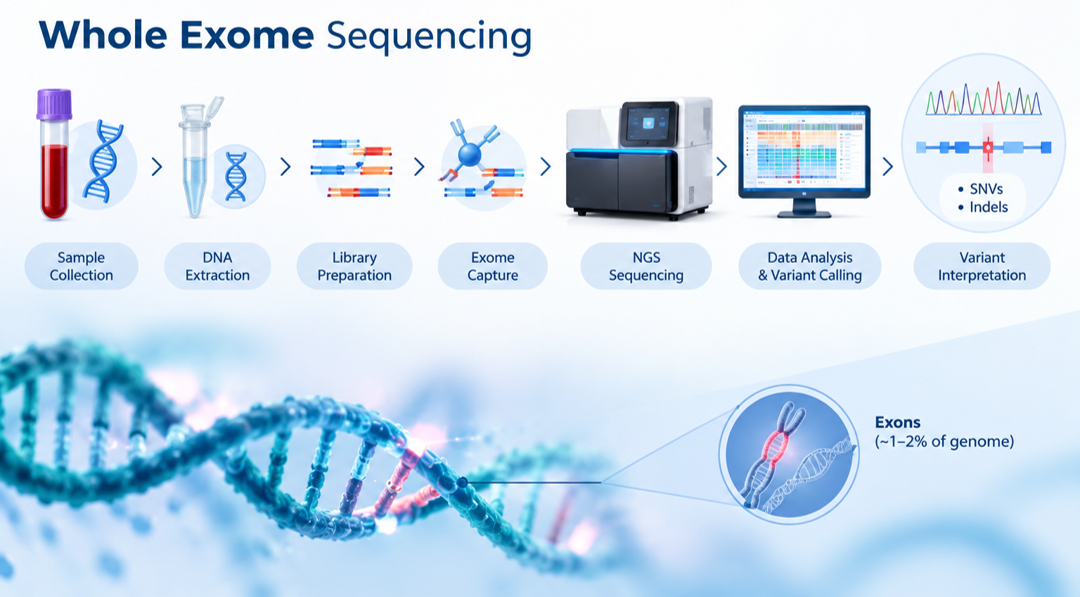
The whole exome sequencing workflow combines laboratory procedures with computational analysis to identify and interpret genetic variants.
1. Sample Collection and DNA Extraction
The process begins with the collection of an appropriate biological sample, such as blood, saliva, or tissue, depending on the study design. Genomic DNA is extracted and assessed for concentration, purity, and integrity before library preparation.
2. Library Preparation
Extracted DNA is fragmented into suitable sizes, followed by the addition of sequencing adapters. These adapters allow the DNA fragments to be amplified and sequenced using an NGS platform.
3. Exome Enrichment
Specialized capture probes are used to enrich DNA fragments corresponding to targeted exonic regions. This step concentrates sequencing resources on protein-coding regions and selected nearby sequences included in the capture design.
4. Next-Generation Sequencing
The enriched DNA library is sequenced using a compatible NGS platform. The resulting reads provide information about the nucleotide sequences across the targeted regions.
5. Bioinformatics Analysis
Raw sequencing data undergo quality control, adapter trimming when required, alignment to a reference genome, and variant calling. Identified variants may include single-nucleotide variants (SNVs) and small insertions or deletions (indels).
6. Variant Annotation and Interpretation
Variants are annotated using relevant databases and computational tools. Researchers may evaluate population frequency, predicted functional impact, clinical evidence, inheritance patterns, and phenotype associations to prioritize variants for further investigation.
Whole Exome Sequencing Workflow:
Sample Collection → DNA Extraction → Library Preparation → Exome Capture → NGS → Bioinformatics Analysis → Variant Annotation and Interpretation
Key Applications of Whole Exome Sequencing
1. Rare Disease and Genetic Disorder Research
Whole exome sequencing helps identify potentially disease-associated variants in individuals with suspected genetic disorders. It is particularly useful when clinical findings suggest a genetic condition but the underlying cause remains unclear.
2. Inherited Disease Investigation
WES can support the investigation of inherited conditions by identifying variants in genes associated with relevant disease phenotypes. Family-based sequencing may further help researchers assess inheritance patterns and prioritize candidate variants.
3. Cancer Genomics
In cancer research, whole exome sequencing can help characterize somatic and germline variants in protein-coding regions. Tumor-normal comparisons may help distinguish acquired variants from inherited variation, supporting studies of tumor biology, disease mechanisms, and potential therapeutic targets.
4. Pharmacogenomics
Genetic variation can influence how individuals metabolize or respond to certain medicines. Whole exome sequencing may contribute to pharmacogenomic research by identifying variants in genes involved in drug metabolism, transport, and response. However, clinical recommendations require appropriate evidence and validated interpretation.
5. Functional Genomics and Biomarker Discovery
WES supports research into the genetic mechanisms underlying disease and biological variation. By identifying coding variants in relevant genes, researchers can investigate candidate disease-associated pathways and generate hypotheses for biomarker discovery and functional studies.
Whole Exome Sequencing vs. Whole Genome Sequencing
Whole exome sequencing and whole genome sequencing (WGS) are both powerful NGS approaches, but they differ in the genomic regions analyzed.
| Feature | Whole Exome Sequencing (WES) | Whole Genome Sequencing (WGS) |
| Target region | Primarily protein-coding regions | Nearly the entire genome |
| Genomic coverage | Exons and other regions included in the capture design | Coding and non-coding regions |
| Data volume | Generally lower | Generally higher |
| Cost and analysis | Often more economical for coding-variant studies | Often requires greater sequencing and analysis resources |
| Key applications | Coding variant discovery and rare disease research | Broad genomic characterization and coding/non-coding variant studies |
| Important limitation | May miss variants outside targeted regions | Detection still depends on sequencing quality and analytical methods |
Which approach should you choose?
WES is often suitable when the primary research objective is to investigate coding variants. WGS may be preferable when broader genomic coverage is required, including the investigation of non-coding regions and certain structural or regulatory variants. The choice depends on the research question, sample type, required variant classes, and available resources.
Benefits of Whole Exome Sequencing
Whole exome sequencing offers several advantages for genomic research:
- Targeted analysis: Focuses sequencing on protein-coding regions relevant to many genetic research questions.
- Cost efficiency: Can reduce sequencing and data-analysis requirements compared with WGS for selected applications.
- Broad gene coverage: Enables simultaneous investigation of thousands of genes.
- Variant discovery: Supports the identification and prioritization of candidate SNVs and small indels.
- Research flexibility: Can be applied to rare disease studies, inherited disorders, cancer genomics, and functional genomics.
Limitations of Whole Exome Sequencing
Despite its advantages, WES has several limitations that researchers should consider.
- Limited genomic scope: Variants in non-targeted intronic, intergenic, and regulatory regions may not be detected.
- Uneven coverage: Some exons, particularly GC-rich or technically challenging regions, may have insufficient coverage.
- Structural variation: Certain copy-number variants and structural rearrangements may be difficult to detect reliably without suitable analytical methods and validation.
- Mosaic variants: Low-frequency variants may be missed depending on sequencing depth, sample composition, and analytical sensitivity.
- Interpretation challenges: Variants of uncertain significance (VUS) require careful assessment and should not automatically be considered disease-causing.
WES results must therefore be interpreted in the context of the study objectives, phenotype, sequencing quality, and relevant supporting evidence. Additional testing may be required when the suspected genetic cause lies outside the assay's detection capabilities.
Why Choose Professional Whole Exome Sequencing Services?
Reliable whole exome sequencing requires more than generating sequencing reads. Sample quality, library preparation, target enrichment, sequencing coverage, and bioinformatics analysis all contribute to the usefulness of the final data. A professional WES service can support researchers through sequencing project planning, sample processing, quality assessment, data generation, and downstream analysis, depending on the selected service package. At CellSeq Solutions LLP, we support genomic research through next-generation sequencing services and associated bioinformatics workflows. Our capabilities include whole exome sequencing, whole genome sequencing, transcriptome sequencing, and other genomics research services.
Whether you are investigating rare genetic variants, studying disease-associated genes, or planning a genomic research project, selecting an appropriate sequencing strategy is essential for obtaining meaningful results.
Conclusion
Whole exome sequencing is a valuable NGS approach for exploring genetic variation within protein-coding regions. Its applications span rare disease research, inherited disorders, cancer genomics, pharmacogenomics, and biomarker discovery.
Although WES offers targeted and cost-effective genomic analysis, its limitations—including incomplete coverage, restricted genomic scope, and variant interpretation challenges—must be considered when selecting a sequencing strategy. By combining appropriate experimental design, high-quality sequencing, and robust bioinformatics analysis, researchers can use whole exome sequencing to generate insights into genetic variation and disease biology.
Planning a Whole Exome Sequencing project?
Connect with CellSeq Solutions LLP to discuss your genomic research requirements and explore suitable sequencing and bioinformatics solutions.
Contact: info@cellseq.in
Website: https://cellseq.in/