

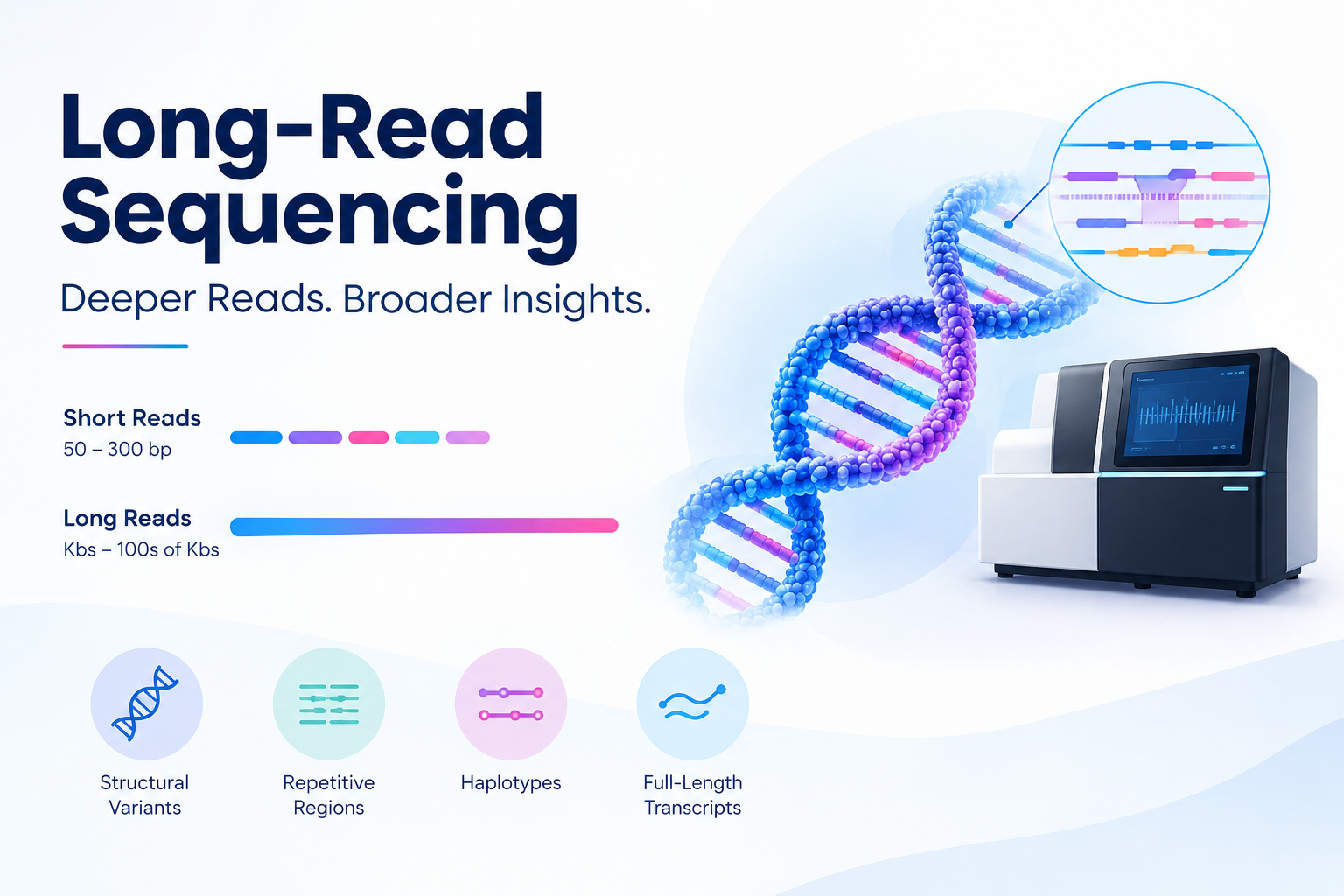
Long-read sequencing is transforming genomic research by enabling researchers to analyze DNA and RNA molecules that are difficult to characterize using conventional short-read sequencing technologies. By generating sequencing reads that can span thousands to millions of bases, long-read sequencing provides improved resolution of repetitive genomic regions, structural variants, complex genomic rearrangements, haplotypes, and full-length transcripts.
Traditional short-read next-generation sequencing (NGS) remains highly useful for applications such as SNV detection, targeted sequencing, and high-throughput variant analysis. However, its relatively short read lengths can make the analysis of complex genomic regions challenging. Long-read sequencing addresses many of these limitations by preserving larger stretches of genomic information within individual sequencing reads. This article explains what long-read sequencing is, how it works, major long-read sequencing platforms, applications, advantages, limitations, and the differences between long-read and short-read sequencing.
What Is Long-Read Sequencing?
Long-read sequencing is a DNA or RNA sequencing approach that generates reads substantially longer than conventional short-read NGS reads. While short-read sequencing typically produces reads in the range of approximately 50–300 bp, long-read technologies can generate reads ranging from several kilobases to, under suitable conditions, hundreds of kilobases or more. The ability to sequence longer molecules provides additional genomic context. For example, a short-read sequencing experiment may generate several independent reads around a repetitive region. A long read may instead span the entire repetitive region and extend into unique flanking sequences, making alignment and structural interpretation easier.
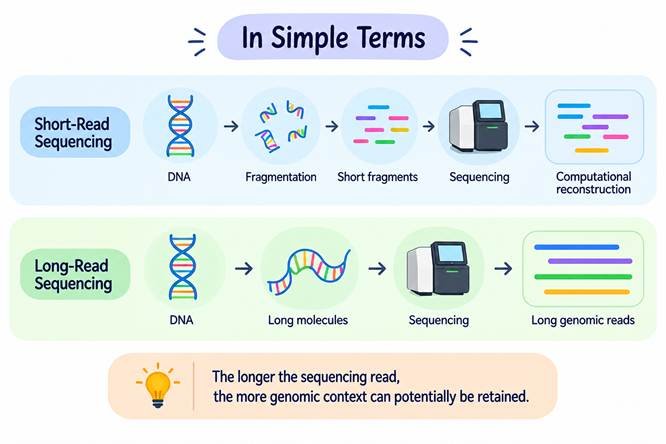
In simple terms:
Short-read sequencing:
DNA → fragmentation → short fragments → sequencing → computational reconstruction
Long-read sequencing:
DNA → long molecules → sequencing → long genomic reads
The longer the sequencing read, the more genomic context can potentially be retained.
Why Is Long-Read Sequencing Important?
The human genome contains many regions that are difficult to analyze using short reads. These include:
- Repetitive DNA
- Segmental duplications
- Large insertions and deletions
- Structural variant breakpoints
- Tandem repeats
- Complex rearrangements
- Highly polymorphic regions
- Difficult-to-map genomic regions
- Full-length transcripts
- Alternative isoforms
Short reads may not span these regions completely, requiring computational inference from multiple fragments. Long reads can directly span many of these regions, providing more continuous genomic information. This makes long-read sequencing particularly valuable for genome assembly, structural variant detection, haplotype phasing, repeat expansion analysis, transcriptome characterization, and complex disease genomics.
How Does Long-Read Sequencing Work?
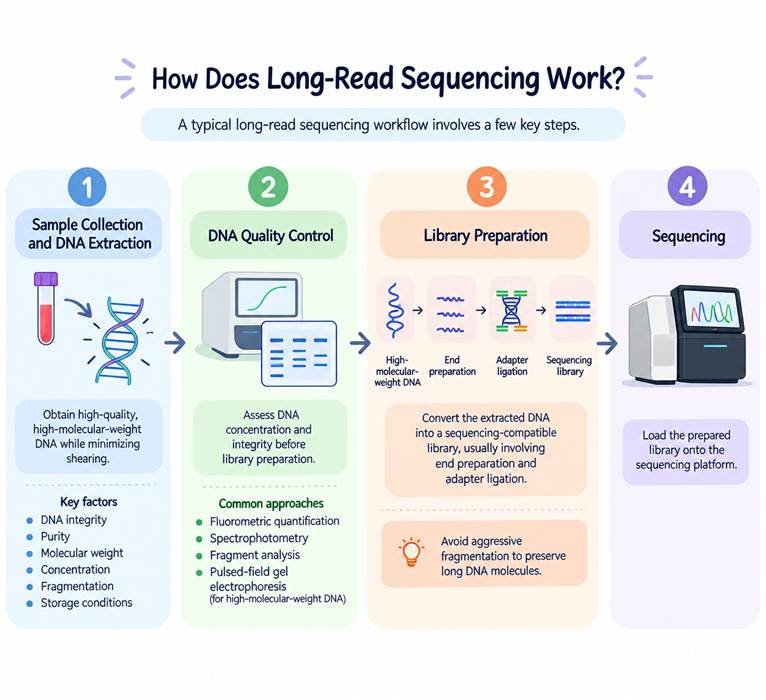
Although the underlying chemistry differs between sequencing platforms, a typical long-read sequencing workflow involves several major steps.
1. Sample Collection and DNA Extraction
High-quality, high-molecular-weight DNA is essential for many long-read sequencing applications. DNA fragmentation can reduce the maximum achievable read length. Therefore, sample handling and extraction methods are often optimized to preserve long DNA molecules. Important considerations include:
- DNA integrity
- DNA purity
- Molecular weight
- Concentration
- Fragmentation
- Storage conditions
For ultra-long sequencing applications, minimizing mechanical shearing is particularly important.
2. DNA Quality Control
Before library preparation, DNA quality is assessed using concentration and integrity measurements. Common approaches include:
- Fluorometric DNA quantification
- Spectrophotometry
- Fragment analysis
- Pulsed-field gel electrophoresis for high-molecular-weight DNA assessment
The appropriate QC strategy depends on the sequencing platform and application.
3. Library Preparation
The extracted DNA is converted into a sequencing-compatible library. Library preparation can involve steps such as:
High-molecular-weight DNA → End preparation → Adapter ligation → Sequencing library
The exact workflow differs between technologies. Because long-read sequencing relies on long DNA molecules, aggressive fragmentation is generally avoided when maximum read length is desired.
4. Sequencing
The prepared library is loaded onto the sequencing platform.
Major Applications of Long-Read Sequencing
1. Structural Variant Detection
One of the most important applications of long-read sequencing is structural variant (SV) detection.
Structural variants include:
- Deletions
- Insertions
- Duplications
- Inversions
- Translocations
- Complex rearrangements
Long reads can directly span structural variant breakpoints, making them particularly useful for identifying variants that are difficult to resolve with short-read sequencing.
For example:
Unique sequence → SV breakpoint → repetitive sequence → unique sequence
A sufficiently long sequencing read may cover the entire event and provide direct evidence of the rearrangement.
2. Genome Assembly
Long reads are particularly valuable for de novo genome assembly. Short-read assemblies can become fragmented when the genome contains repetitive sequences. Long reads can bridge these repetitive regions and generate more contiguous assemblies.
A simplified assembly workflow is:
Long reads → Error correction → Read overlap → Assembly → Polishing → Genome annotation
Long-read genome assemblies can improve:
- Contig continuity
- Chromosome-scale assembly
- Repeat resolution
- Structural variant representation
- Gene model completeness
3. Repetitive Region Analysis
Repetitive DNA is one of the major challenges in genome analysis.
Examples include:
- Tandem repeats
- Satellite DNA
- Segmental duplications
- Short tandem repeats
- Transposable elements
Short reads may align ambiguously to these regions. Long reads can potentially span the repetitive sequence and include unique flanking DNA, improving the ability to determine its genomic location and structure.
4. Repeat Expansion Disorders
Repeat expansions occur when specific repetitive sequences become abnormally expanded.
Long-read sequencing can provide direct information about:
- Repeat length
- Repeat composition
- Repeat interruptions
- Flanking sequences
- Complex repeat structures
This can be important in the investigation of several inherited neurological and genetic disorders.
5. Haplotype Phasing
Phasing determines which variants occur together on the same chromosome.
Short reads may identify variants but cannot always determine whether two variants are located on the same haplotype.
Long reads can sometimes span multiple heterozygous variants within the same molecule.
For example:
Variant A —— Variant B —— Variant C
A single long read containing all three variants provides direct evidence about their phase.
This is particularly useful in:
- Rare disease genomics
- Population genomics
- Cancer genomics
- Compound heterozygosity analysis
6. Full-Length Transcriptome Sequencing
Long-read sequencing is also highly valuable for transcriptomics. Short-read RNA sequencing typically requires computational reconstruction of transcripts from smaller fragments. Long-read RNA sequencing can capture much longer portions of individual transcripts.
This can improve characterization of:
- Alternative splicing
- Novel isoforms
- Alternative transcription start sites
- Alternative polyadenylation
- Fusion transcripts
- Complex transcript structures
Therefore, long-read transcriptomics can provide a more direct view of transcript architecture.
7. Epigenomics
Some long-read sequencing approaches can provide information about DNA modifications. Oxford Nanopore sequencing, for example, can detect changes in the electrical signal associated with modified bases.
This can support research into:
- DNA methylation
- Epigenetic regulation
- Disease-associated methylation patterns
- Allele-specific methylation
The exact capabilities depend on the sequencing platform, basecalling software, and analysis workflow.
Advantages of Long-Read Sequencing
1. Longer Genomic Context
Long reads provide more sequence context around variants and genomic features.
2. Improved Structural Variant Detection
Large insertions, deletions, inversions, and complex rearrangements can be more directly characterized.
3. Better Resolution of Repetitive Regions
Long reads can span regions that short reads may map ambiguously.
4. Improved Genome Assembly
Long reads can produce more contiguous genome assemblies.
5. Better Haplotype Resolution
Multiple variants can potentially be phased on the same DNA molecule.
6. Full-Length Transcript Characterization
Long-read RNA sequencing can identify complete transcript structures.
7. Potential for Native DNA Analysis
Some platforms can extract additional information from native DNA molecules, including methylation-associated signals.
Limitations of Long-Read Sequencing
Despite its advantages, long-read sequencing is not universally superior.
1. DNA Quality Requirements
Many long-read workflows benefit from high-molecular-weight DNA. Poor sample handling can substantially reduce read length.
2. Sequencing Errors
Error profiles differ between platforms. PacBio HiFi provides very high consensus accuracy, while nanopore accuracy has improved substantially but remains dependent on chemistry, basecaller, read type, and workflow.
3. Cost
The total cost depends on platform, sequencing depth, library preparation, sample type, and computational requirements.
4. Computational Requirements
Long-read datasets require specialized tools for:
- Basecalling
- Alignment
- Variant calling
- Genome assembly
- Structural variant detection
- Phasing
- Transcript analysis
5. Bioinformatics Complexity
Long-read analysis requires workflows specifically optimized for long-read data rather than simply applying conventional short-read pipelines.