

Introduction
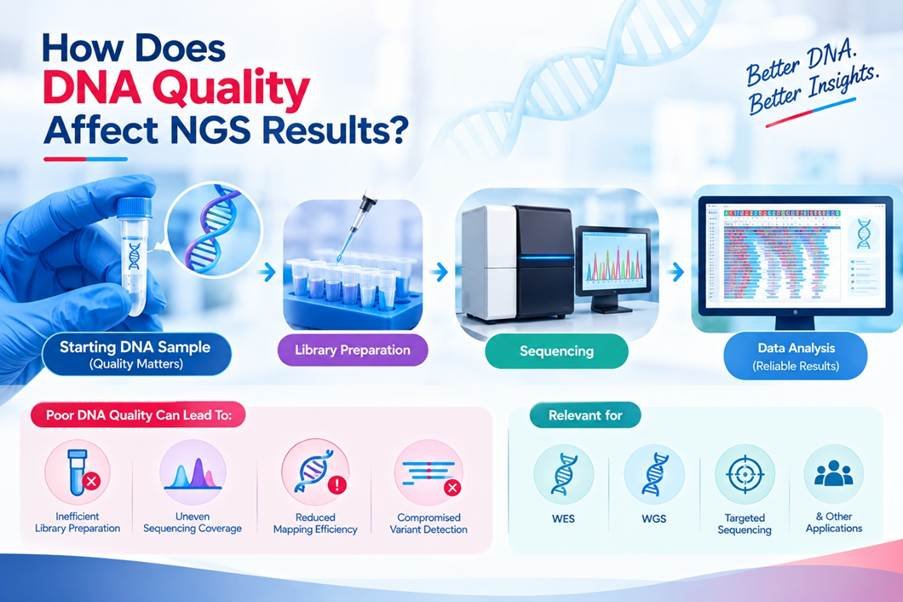
Next-Generation Sequencing (NGS) has transformed genomic research by enabling the analysis of millions of DNA fragments simultaneously. However, the accuracy and reliability of NGS results depend not only on sequencing technology but also on the quality of the starting DNA sample. Poor DNA quality can affect library preparation, sequencing coverage, mapping efficiency, and downstream variant detection. Even with advanced sequencing platforms, degraded or contaminated DNA may compromise the quality of genomic data.Understanding how DNA quality affects NGS results is essential for researchers working with Whole Exome Sequencing (WES), Whole Genome Sequencing (WGS), targeted sequencing, and other genomic applications.
1. What Defines Good-Quality DNA for NGS?
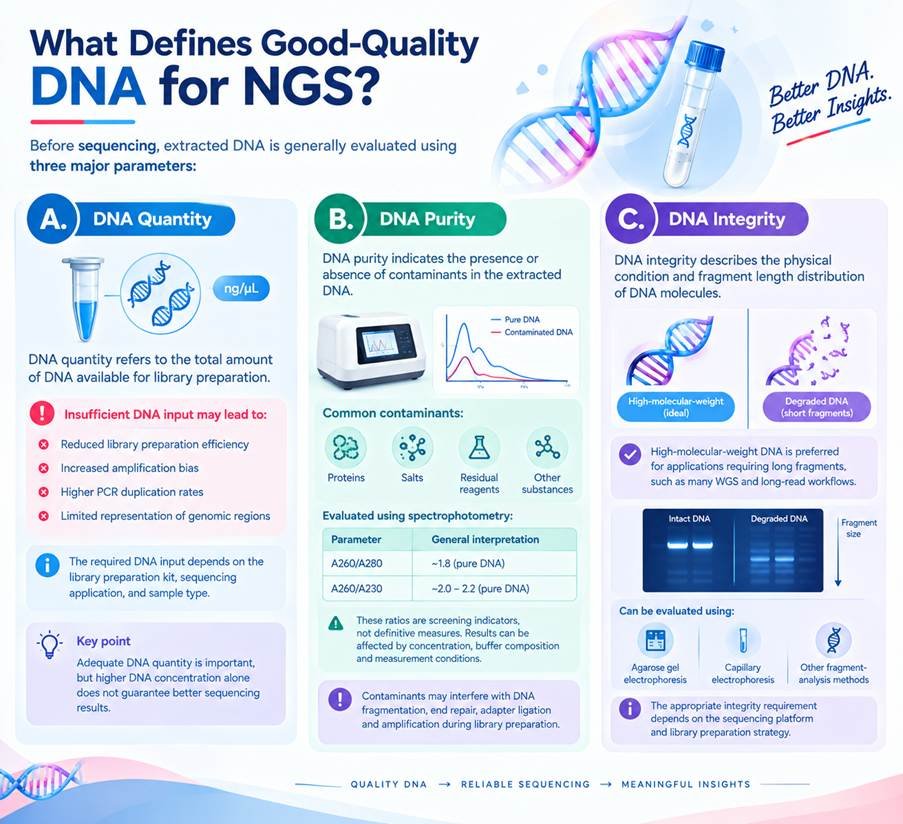
Before sequencing, extracted DNA is generally evaluated using three major parameters:
A. DNA Quantity
DNA quantity refers to the total amount of DNA available for library preparation. Insufficient DNA input may lead to:
- Reduced library preparation efficiency.
- Increased amplification bias.
- Higher PCR duplication rates in amplification-based workflows.
- Limited representation of genomic regions.
The required DNA input depends on the library preparation kit, sequencing application, and sample type.
Key point: Adequate DNA quantity is important, but higher DNA concentration alone does not guarantee better sequencing results.
B. DNA Purity
DNA purity indicates the presence or absence of contaminants in the extracted DNA. Common contaminants include proteins, salts, residual extraction reagents, and other substances that may interfere with enzymatic reactions. DNA purity is commonly assessed using spectrophotometric measurements:
| Parameter | General interpretation |
| A260/A280 | Approximately 1.8 is commonly associated with relatively pure DNA. |
| A260/A230 | Approximately 2.0–2.2 is generally expected for relatively pure DNA. |
These ratios are screening indicators rather than definitive measures of DNA suitability. Results can be affected by concentration, buffer composition, and measurement conditions.
Contaminants may interfere with DNA fragmentation, end repair, adapter ligation, and amplification during library preparation.
C. DNA Integrity
DNA integrity describes the physical condition and fragment length distribution of DNA molecules. High-molecular-weight DNA is generally preferred for applications requiring long DNA fragments, such as many WGS and long-read sequencing workflows. Degraded DNA contains shorter fragments and may show an altered fragment-size distribution. DNA integrity can be evaluated using agarose gel electrophoresis, capillary electrophoresis, or other fragment-analysis methods. The appropriate integrity requirement depends on the sequencing platform and library preparation strategy.
2. How Does Poor DNA Quality Affect NGS Results?
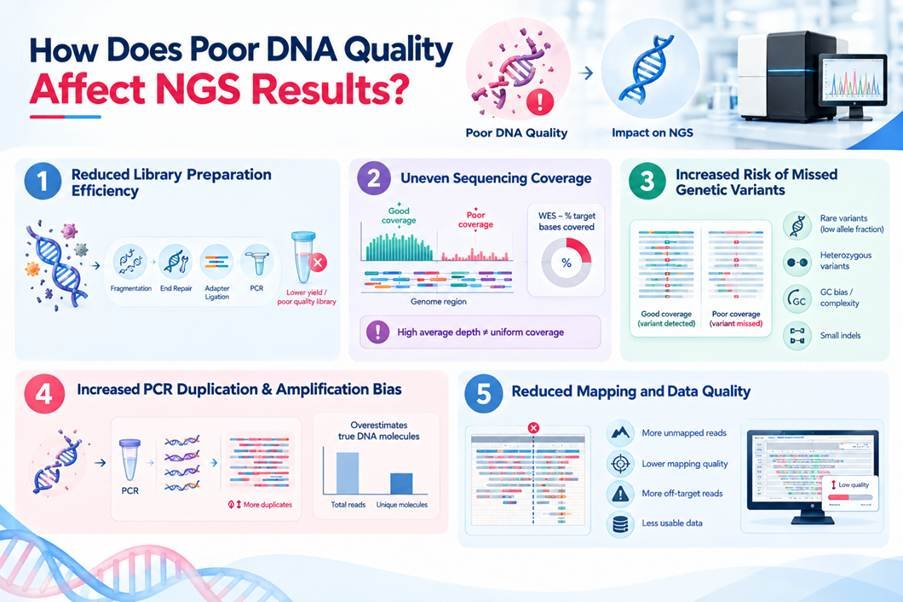
1. Reduced Library Preparation Efficiency
NGS library preparation involves DNA fragmentation or input processing, end repair, adapter ligation, and sometimes PCR amplification. Damaged or contaminated DNA can interfere with these steps, resulting in lower library yield or inconsistent library quality. This may lead to additional sample processing or library preparation failure.
2. Uneven Sequencing Coverage
Sequencing coverage describes how many sequencing reads support a genomic position. Poor DNA integrity, GC-content bias, and inefficient library preparation can contribute to uneven coverage across genomic regions. For example, some regions may receive adequate sequencing depth while others remain insufficiently covered. In WES, this can affect the percentage of targeted bases reaching the required coverage threshold.
Important: High average sequencing depth does not necessarily mean uniform coverage across all target regions.
3. Increased Risk of Missed Genetic Variants
Reliable variant detection requires sufficient, high-quality sequencing reads at the genomic position being evaluated. If a region has inadequate coverage or poor mapping quality, genetic variants may remain undetected.
This is particularly relevant for:
- Rare variants with low allele fractions.
- Heterozygous variants in poorly covered regions.
- Regions affected by GC bias or sequence complexity.
- Small insertions and deletions in challenging genomic regions.
Poor DNA quality does not automatically produce false variants, but it can reduce confidence in variant detection and increase the number of regions requiring further investigation.
4. Increased PCR Duplication and Amplification Bias
When DNA input is limited, some library preparation workflows rely on PCR amplification. Excessive amplification can produce duplicate sequencing reads and uneven representation of original DNA molecules. As a result, the total number of sequencing reads may overestimate the number of independent DNA molecules represented in the library. This can reduce effective sequencing depth and compromise variant detection, particularly in low-frequency variant analysis.
5. Reduced Mapping and Data Quality
DNA contamination, short fragments, and low-complexity sequences can affect alignment to the reference genome. Potential consequences include:
- Increased unmapped reads.
- Reduced mapping quality.
- Increased off-target reads.
- Lower usable sequencing data.
The magnitude of these effects depends on the contaminant, sequencing platform, library preparation method, and bioinformatics pipeline.
3. DNA Quality Requirements Across Different NGS Applications
Different sequencing applications have different DNA input and integrity requirements.
| Application | Important DNA quality considerations |
| Whole Exome Sequencing (WES) | Adequate input, purity, library complexity, and uniform target coverage. |
| Whole Genome Sequencing (WGS) | DNA integrity, sufficient input, and representative genomic coverage. |
| Targeted NGS | Adequate input and reliable representation of targeted regions. |
| RNA Sequencing (RNA-seq) | RNA integrity and purity are critical; DNA QC requirements alone are insufficient. |
| Long-read sequencing | High-molecular-weight DNA is often particularly important. |
There is no single DNA quality threshold that applies to every NGS application. Requirements should be determined according to the library preparation protocol, sequencing platform, and research objective.
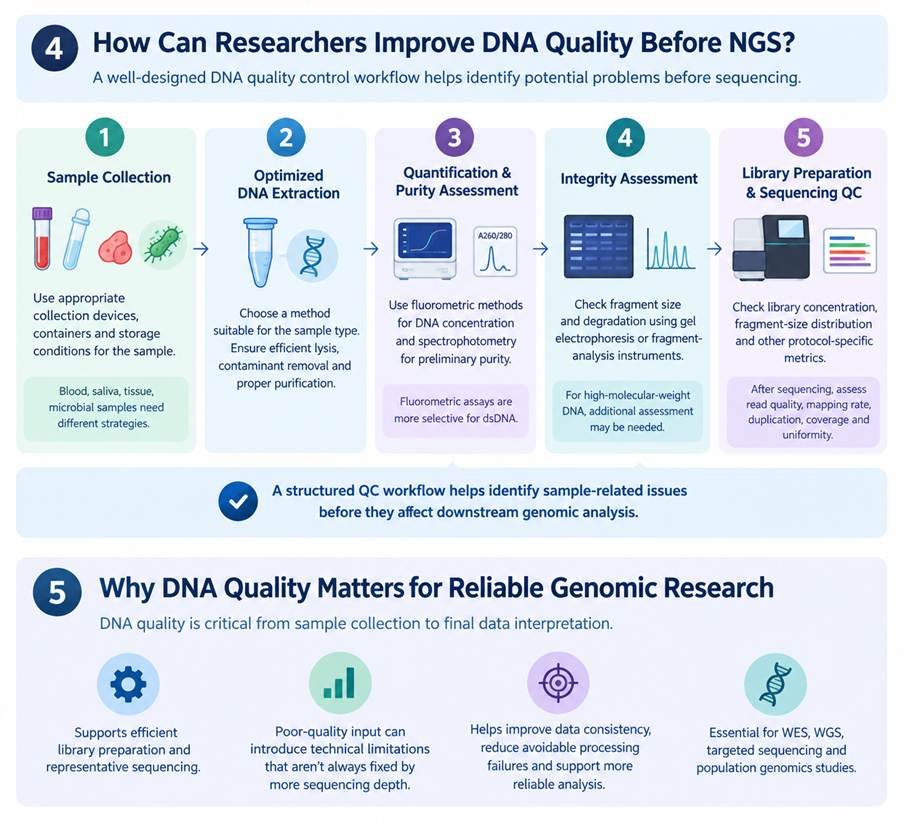
4. How Can Researchers Improve DNA Quality Before NGS?
A well-designed DNA quality control workflow can help identify potential problems before sequencing.
Step 1: Appropriate Sample Collection
Use suitable collection devices, sample containers, and storage conditions for the biological material. Blood, saliva, tissue, and microbial samples may require different collection and preservation strategies.
Step 2: Optimized DNA Extraction
Select an extraction method appropriate for the sample type. Efficient cell lysis, removal of contaminants, and appropriate purification are important for obtaining DNA suitable for downstream processing.
Step 3: DNA Quantification and Purity Assessment
Use appropriate methods such as fluorometric quantification for DNA concentration and spectrophotometry for preliminary purity assessment. Fluorometric assays are generally more selective for double-stranded DNA than absorbance-based measurements.
Step 4: DNA Integrity Assessment
Evaluate fragment size and degradation using gel electrophoresis or suitable fragment-analysis instruments. For applications requiring high-molecular-weight DNA, additional integrity assessment may be necessary.
Step 5: Library Preparation and Sequencing QC
After DNA passes the relevant quality checks, evaluate library concentration, fragment-size distribution, and other protocol-specific metrics. Following sequencing, assess read quality, mapping rate, duplication, coverage depth, coverage uniformity, and other application-specific metrics.
A structured QC workflow helps identify sample-related issues before they affect downstream genomic analysis.
5. Why DNA Quality Matters for Reliable Genomic Research
DNA quality is a critical component of the entire NGS workflow, from sample collection to final data interpretation. High-quality DNA can support efficient library preparation and representative sequencing, while poor-quality input may introduce technical limitations that cannot always be corrected through increased sequencing depth. For researchers conducting WES, WGS, targeted sequencing, or population genomics studies, evaluating DNA quality before sequencing can help improve data consistency, reduce avoidable processing failures, and support more reliable downstream analysis.
Conclusion
Reliable NGS results begin with quality DNA.
DNA quantity, purity, and integrity influence library preparation, sequencing coverage, mapping performance, and variant detection. However, DNA quality is only one component of sequencing success. Library preparation, sequencing platform, experimental design, and bioinformatics analysis also contribute to the final results. At CellSeq Solutions LLP, we support genomic research workflows involving DNA extraction, NGS, Whole Exome Sequencing (WES), Whole Genome Sequencing (WGS), SNP genotyping, and genomic data analysis. Whether you are planning a targeted sequencing experiment or a large-scale genomic study, appropriate sample processing and quality assessment are essential steps toward generating meaningful genomic insights.