

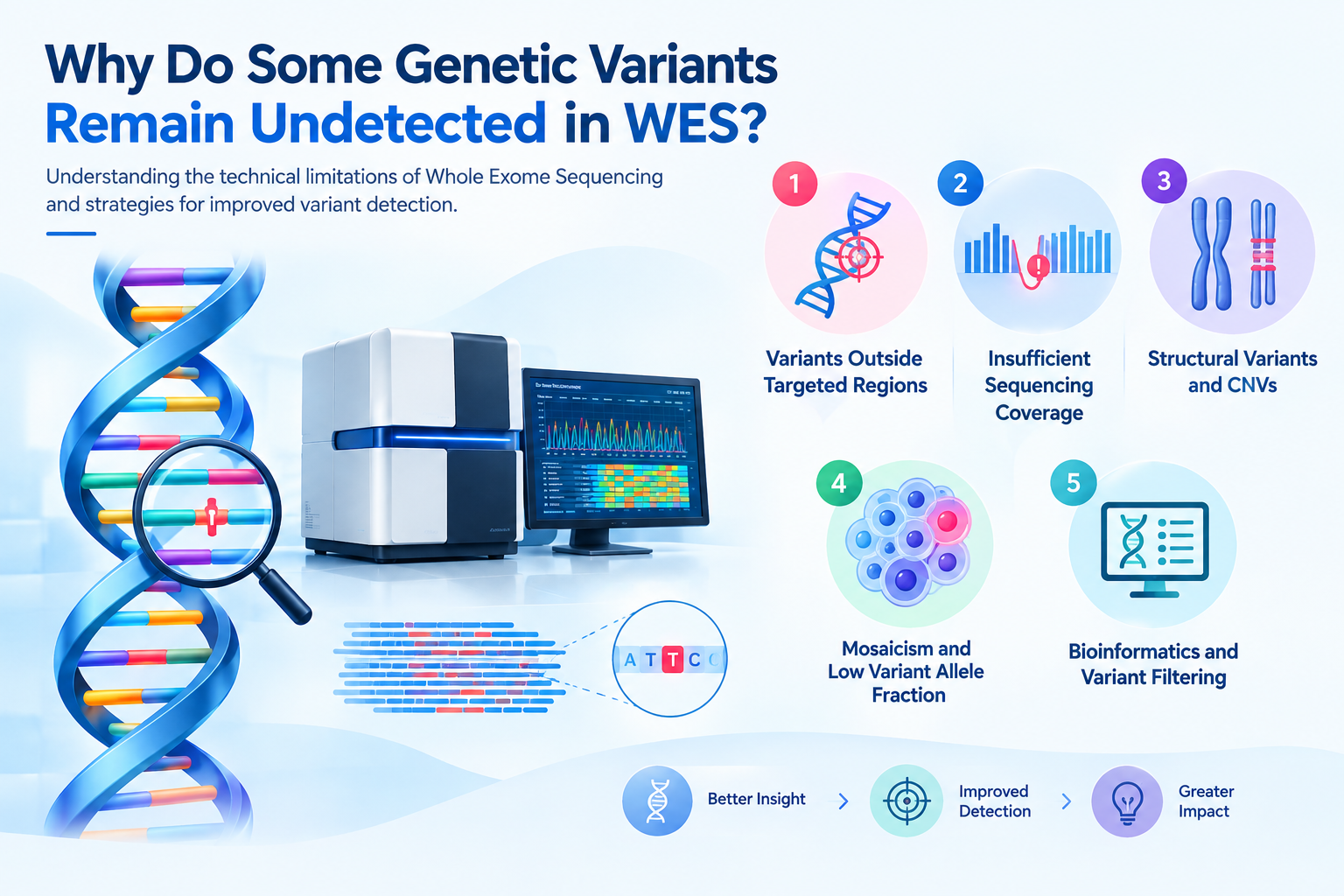
Understanding the technical limitations of Whole Exome Sequencing and strategies for improved variant detection.
Introduction
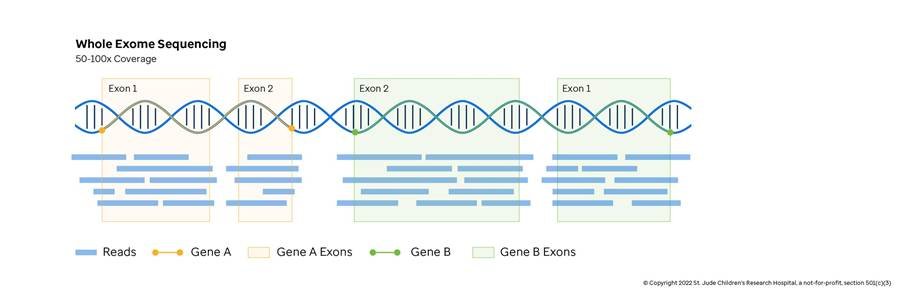
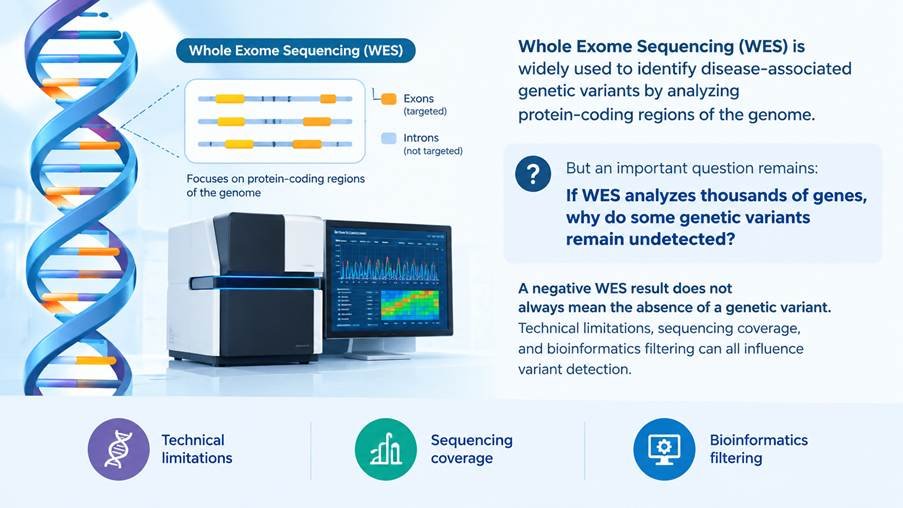
Whole exome sequencing (WES) is widely used to identify disease-associated genetic variants. It analyzes the protein-coding regions of the genome.
However, an important question remains: If WES analyzes thousands of genes, why do some genetic variants remain undetected? A negative WES result does not always mean the absence of a genetic variant.
1. Variants Outside Targeted Regions
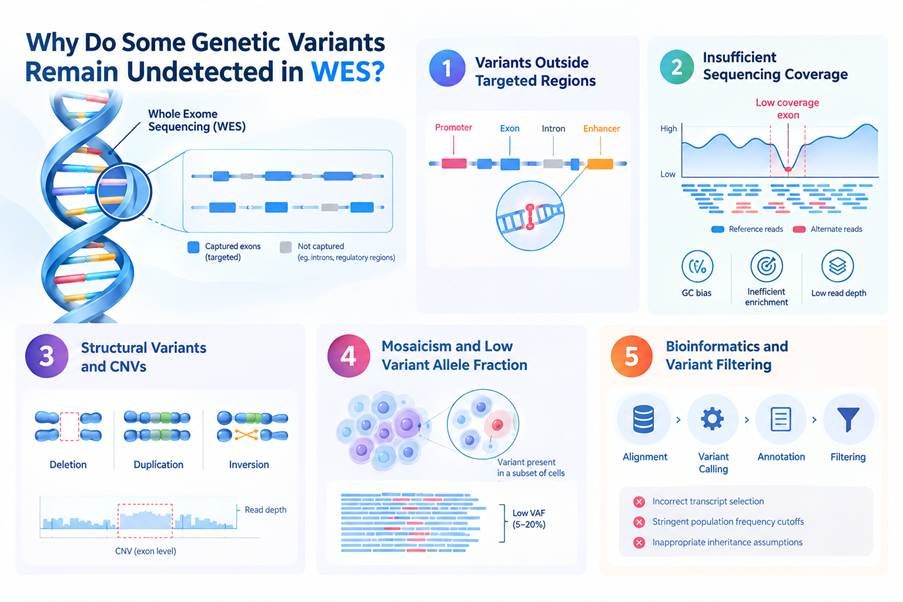
WES primarily captures protein-coding exons and selected splice regions. Deep intronic, promoter, enhancer, and other regulatory variants may remain undetected because they are generally not included in the capture design.
2. Insufficient Sequencing Coverage
Uneven coverage can leave certain exons inadequately sequenced.
In Whole exome sequencing, low read depth, GC bias, and inefficient target enrichment can reduce alternate allele representation.
High average coverage does not guarantee adequate coverage across every exon.
3. Structural Variants and CNVs
Large deletions, duplications, and inversions can be challenging to detect. Conventional WES pipelines make detection difficult.
Although read-depth-based CNV analysis is possible, exon-level alterations may be missed. This occurs due to coverage variability and mapping limitations.
4. Mosaicism and Low Variant Allele Fraction
Variants present in only a subset of cells may occur at low variant allele fractions.
Additionally, standard germline variant-calling pipelines may filter these variants because of insufficient alternate read support or stringent allele fraction thresholds.
5. Bioinformatics and Variant Filtering
Even when a variant is present in sequencing data, Whole exome sequencing may miss it during alignment. It may also be missed during variant calling, annotation, or filtering. This risk persists despite data quality and standard pipelines.
Moreover, inaccurate transcript selection, strict population frequency cutoffs, and inappropriate inheritance assumptions can also remove relevant variants. These factors reduce the chance to detect clinically important findings. Awareness of these pitfalls helps guide interpretation in exome analyses. Careful review remains essential.
How Can Researchers Improve Variant Detection?
- Review coverage depth, mapping quality, and poorly covered regions.
- Reassess variant-calling parameters and filtering criteria.
- Consider WGS for broader genomics coverage.
- Use RNA-seq, targeted deep sequencing, MLPA, or long-read sequencing when appropriate for the suspected variant.
Conclusion
A negative Whole exome sequencing result is not always the end of a genetic investigation, and may require additional analysis. Understanding assay limitations, sequencing quality, and bioinformatics workflows is essential for interpreting results and selecting complementary genomics approaches ultimately today.
At CellSeq Solutions LLP, we support genomics research through multiple platforms and methods to accelerate discoveries worldwide and foster collaboration. Our offerings include sequencing platforms, data analysis services, and cross-disciplinary collaboration to support diverse research projects across academic clinical institutions.
Looking for genomics sequencing support for your research?
Email: info@cellseq.in