

Introduction
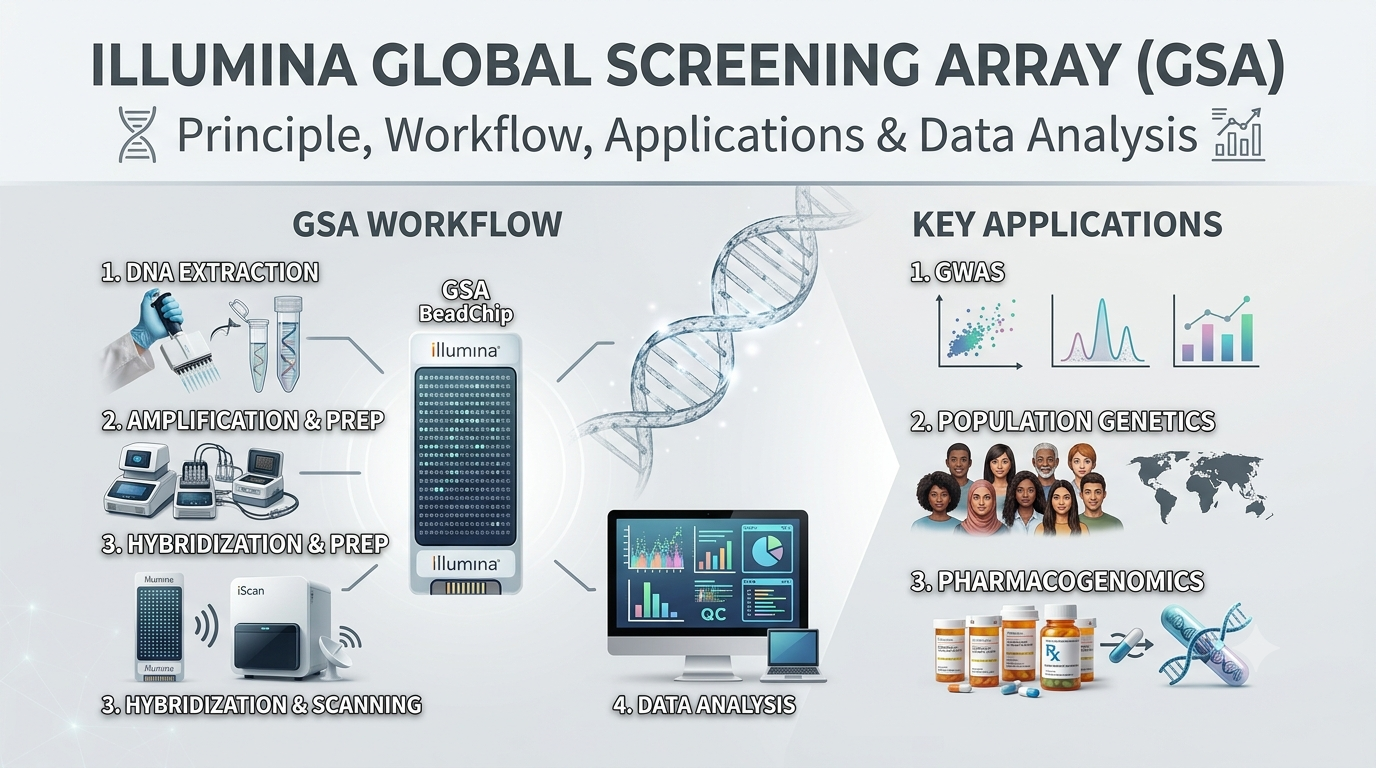
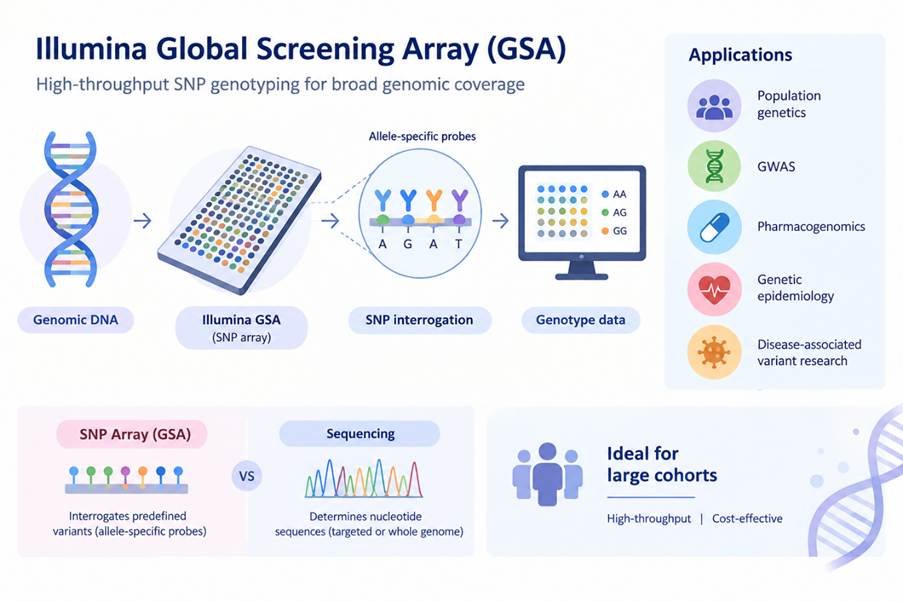
Genotyping technologies have become an important part of modern genetic research, enabling researchers to study large numbers of genetic variants across the genome efficiently. One widely used platform for this purpose is the Illumina Global Screening Array (GSA). The GSA is a high-throughput SNP genotyping array designed to provide broad genomic coverage while supporting applications such as population genetics, genome-wide association studies (GWAS), pharmacogenomics, genetic epidemiology, and disease-associated variant research. Unlike sequencing-based approaches that determine nucleotide sequences across targeted or whole-genome regions, SNP arrays interrogate predefined genomic variants using allele-specific probes. This makes GSA particularly useful when the research objective involves studying a large cohort at a comparatively high scale.
What is the Global Screening Array (GSA)?
The Global Screening Array (GSA) is an Illumina microarray platform designed for high-throughput genotyping. It contains hundreds of thousands of markers distributed across the genome. These markers can include common genetic variants as well as variants selected for applications such as:
- Genome-wide association studies
- Population genetics
- Pharmacogenomics
- Disease-associated variant screening
- Genetic epidemiology
- Polygenic risk research
- Imputation and genomic analyses
The exact marker content depends on the GSA version and array manifest being used.
How Does GSA Genotyping Work?
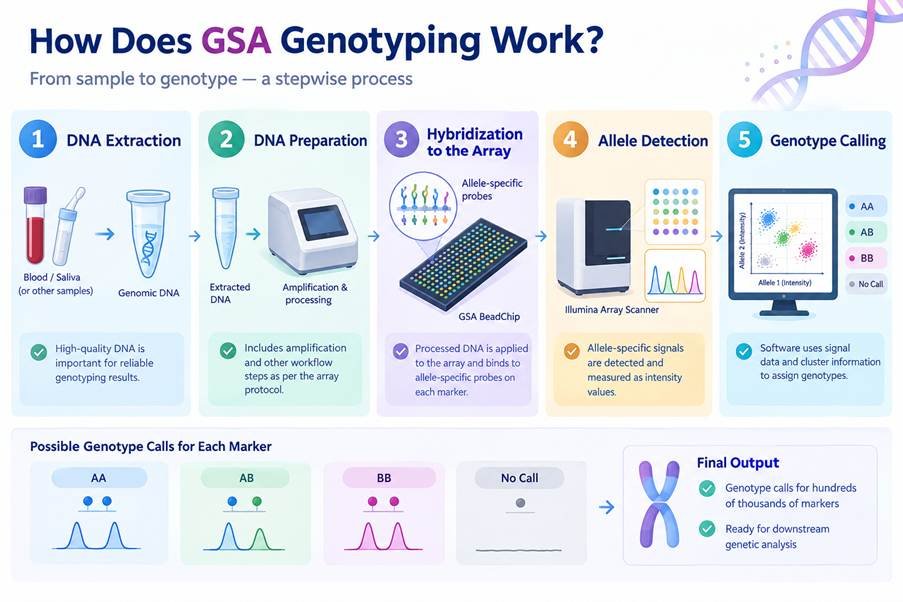
GSA-based genotyping generally follows a series of laboratory and computational steps.
1. DNA Extraction
High-quality genomic DNA is isolated from biological samples such as blood, saliva, or other suitable specimens. DNA quality and concentration are important because poor-quality input DNA can affect downstream genotyping performance.
2. DNA Preparation
The extracted DNA undergoes the required amplification and processing steps according to the array workflow.
3. Hybridization to the Array
The processed DNA is applied to the GSA BeadChip. Each marker on the array is represented by probes designed to distinguish between specific alleles.
4. Allele Detection
The array detects allele-specific signals generated from the hybridization and extension reactions. The resulting signal intensities are measured using an Illumina array scanner.
5. Genotype Calling
The raw signal data are processed using appropriate software and cluster information to assign genotypes. Depending on the genotype, a marker may be classified as:
- AA
- AB
- BB
- No Call
The final genotype calls form the basis of downstream genetic analysis.
Understanding GSA Data
GSA output can contain several types of information depending on the software and reporting pipeline. Common fields may include:
| Field | Description |
| Sample ID | Identifier assigned to the sample |
| Sample Name | Sample name or laboratory identifier |
| SNP Name / IlmnID | Array marker identifier |
| Chr | Chromosome |
| Position | Genomic coordinate |
| Allele1/2 - AB | Genotype represented in A/B notation |
| Allele1/2 - Top | Genotype represented using Top-strand alleles |
| Plus/Minus Alleles | Strand-oriented allele information |
| Genotype | Final genotype call |
| Call Rate | Proportion of successfully called markers |
Understanding these fields is particularly important when GSA reports need to be converted between different analysis or reporting formats.
What is Call Rate in GSA?
Call rate is an important quality-control metric in SNP genotyping. It represents the proportion of markers for which a reliable genotype call was generated. The basic calculation is:
Call Rate (%) = Number of Successfully Called Markers / Total Markers × 100
For example, if 640,000 markers out of 654,027 markers receive genotype calls:
Call Rate = (640,000 / 654,027) × 100 ≈ 97.9%
A high call rate generally indicates that a large proportion of the interrogated markers produced usable genotype calls. However, call rate should not be considered in isolation. Sample-level and marker-level quality-control metrics should be evaluated together.
GSA Quality Control
Quality control is an essential step before downstream genetic analysis. Important QC parameters can include:
Sample Call Rate
Identifies samples with a large proportion of missing genotype calls.
Marker Call Rate
Identifies SNP markers that consistently produce poor-quality or missing calls across samples.
Genotype Clustering
Cluster plots can help evaluate how clearly AA, AB, and BB genotype groups are separated.
Sex Check
Reported genetic sex can be compared with expected sample information to identify possible sample mix-ups.
Heterozygosity
Unexpected heterozygosity levels can indicate potential sample-quality or contamination issues.
Duplicate and Relatedness Checks
Genotype data can be used to identify duplicate samples or unexpected genetic relationships within a cohort.
Hardy-Weinberg Equilibrium
For appropriate study designs, HWE testing can be used as part of marker-level QC, particularly in population-based analyses.
GSA in Genome-Wide Association Studies
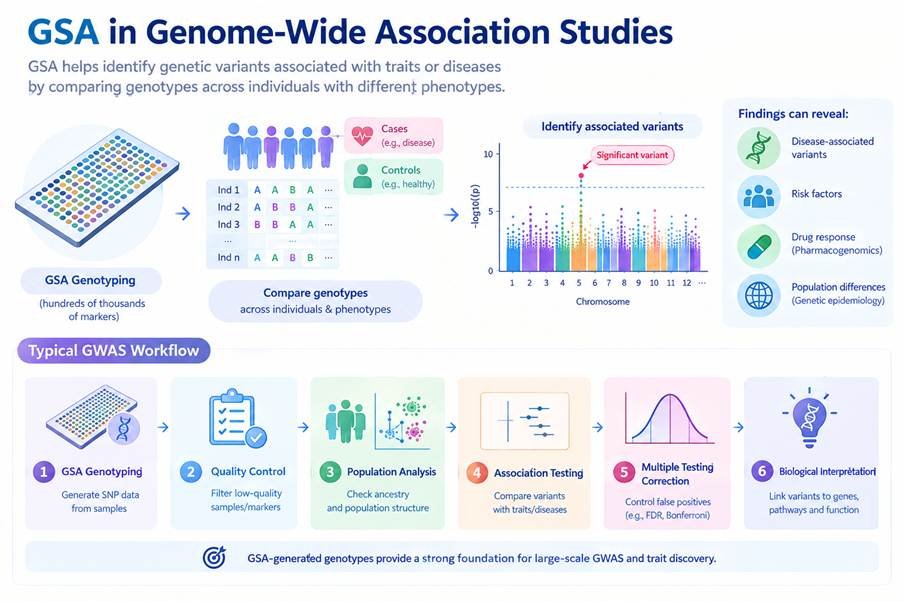
One of the major applications of GSA is Genome-Wide Association Studies (GWAS). In a GWAS, genetic variants are compared across individuals with different phenotypes or disease statuses to identify variants associated with a trait.
A typical workflow is:
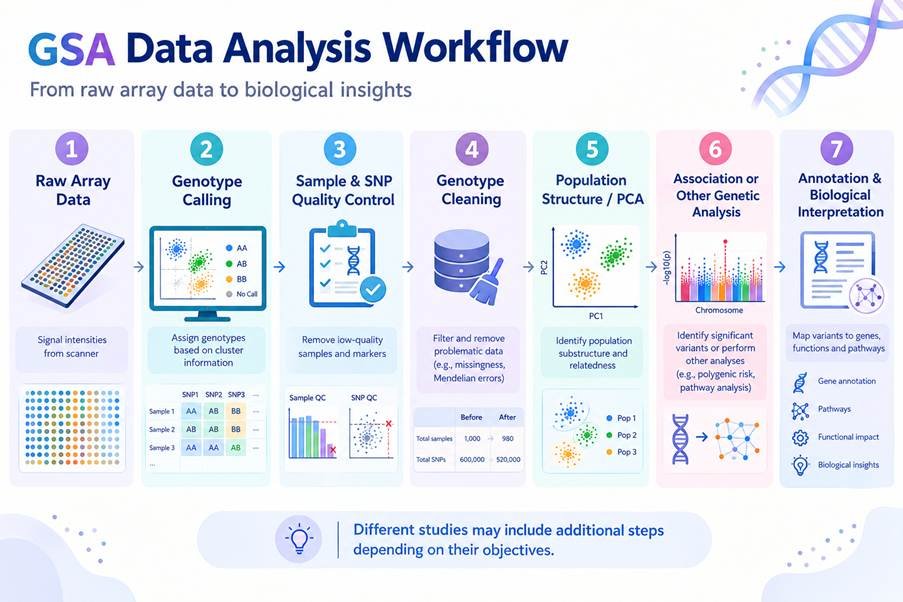
GSA Genotyping → Quality Control → Population Analysis → Association Testing → Multiple Testing Correction → Biological Interpretation
GSA-generated genotypes can therefore serve as the foundation for large-scale association studies.
GSA and Pharmacogenomics
GSA data can also support pharmacogenomic research by providing genotype information for variants relevant to drug response. Depending on the array version and study design, researchers may investigate variants associated with:
- Drug metabolism
- Drug transport
- Drug response
- Adverse drug reactions
- Pharmacokinetic variation
For specialized pharmacogenomic interpretation, however, researchers should verify whether the required variants are directly represented on the specific GSA version being used.
GSA for Population Genetics
Because the array contains a large number of genome-wide markers, GSA data can be used to study genetic variation across populations. Analyses may include:
- Principal Component Analysis (PCA)
- Population structure
- Genetic relatedness
- Ancestry-related analyses
- Genetic diversity
- Identity-by-descent analysis
These approaches can help researchers understand genetic similarities and differences within and between study populations.
GSA and Genomic Imputation
Another important application is genotype imputation. Genotyping arrays directly measure only the variants represented on the array. Imputation can estimate genotypes at additional variants that were not directly assayed by using linkage disequilibrium patterns and an appropriate reference panel. A simplified workflow is:
GSA Genotypes → QC → Phasing → Reference Panel → Imputation → Post-imputation QC
The quality of imputation depends on factors such as array content, population background, reference panel quality, and genomic region.
GSA vs Sequencing
GSA and sequencing technologies answer different types of research questions.
| Feature | GSA | WES/WGS |
| Technology | SNP microarray | DNA sequencing |
| Primary output | Genotypes at predefined markers | Sequence reads and variants |
| Genome coverage | Selected markers | Exome or genome |
| Throughput | High | High, but data-intensive |
| Data volume | Relatively smaller | Relatively larger |
| Novel variant discovery | Limited | Possible |
| GWAS | Widely used | Also possible |
| Imputation | Common application | Usually not the primary purpose |
Therefore, the choice between GSA and sequencing depends on the study objective, cohort size, required variant resolution, and budget.
GSA Data Analysis Workflow
Why GSA is Useful for Large Cohort Studies
The major advantage of SNP arrays is their ability to generate genome-wide genotype information across a large number of samples using a standardized assay. This makes GSA-based approaches useful for studies involving:
- Large patient cohorts
- Population-scale datasets
- GWAS
- Genetic epidemiology
- Pharmacogenomic research
- Disease-associated variant screening
- Genomic research requiring standardized SNP profiles
The relatively compact nature of array data can also simplify storage and downstream computational processing compared with whole-genome sequencing datasets.
Important Considerations Before Using GSA
Before starting a GSA project, researchers should consider:
- Array version – marker content varies between GSA versions.
- Manifest – the correct manifest is essential for interpreting marker IDs and genomic coordinates.
- Genome build – genomic positions should be interpreted using the appropriate reference genome.
- Sample quality – DNA quality can affect genotype calling.
- QC thresholds – thresholds should be selected according to the study design.
- Reference panel – important when performing genotype imputation.
- Downstream objective – GWAS, population analysis, pharmacogenomics, and clinical research may require different analytical workflows.
Conclusion
The Illumina Global Screening Array (GSA) provides a practical approach for high-throughput genome-wide SNP genotyping. By combining broad marker coverage with scalable genotyping, GSA can support applications ranging from GWAS and population genetics to pharmacogenomics and large-cohort genetic studies. However, obtaining reliable biological insights from GSA data requires more than simply generating genotype calls. Proper sample QC, marker QC, genotype interpretation, strand/allele handling, genomic-coordinate verification, and downstream statistical analysis are essential components of a robust GSA workflow. For researchers working with large cohorts, GSA can provide a standardized starting point for transforming genome-wide genotype data into meaningful genetic insights.