

Introduction
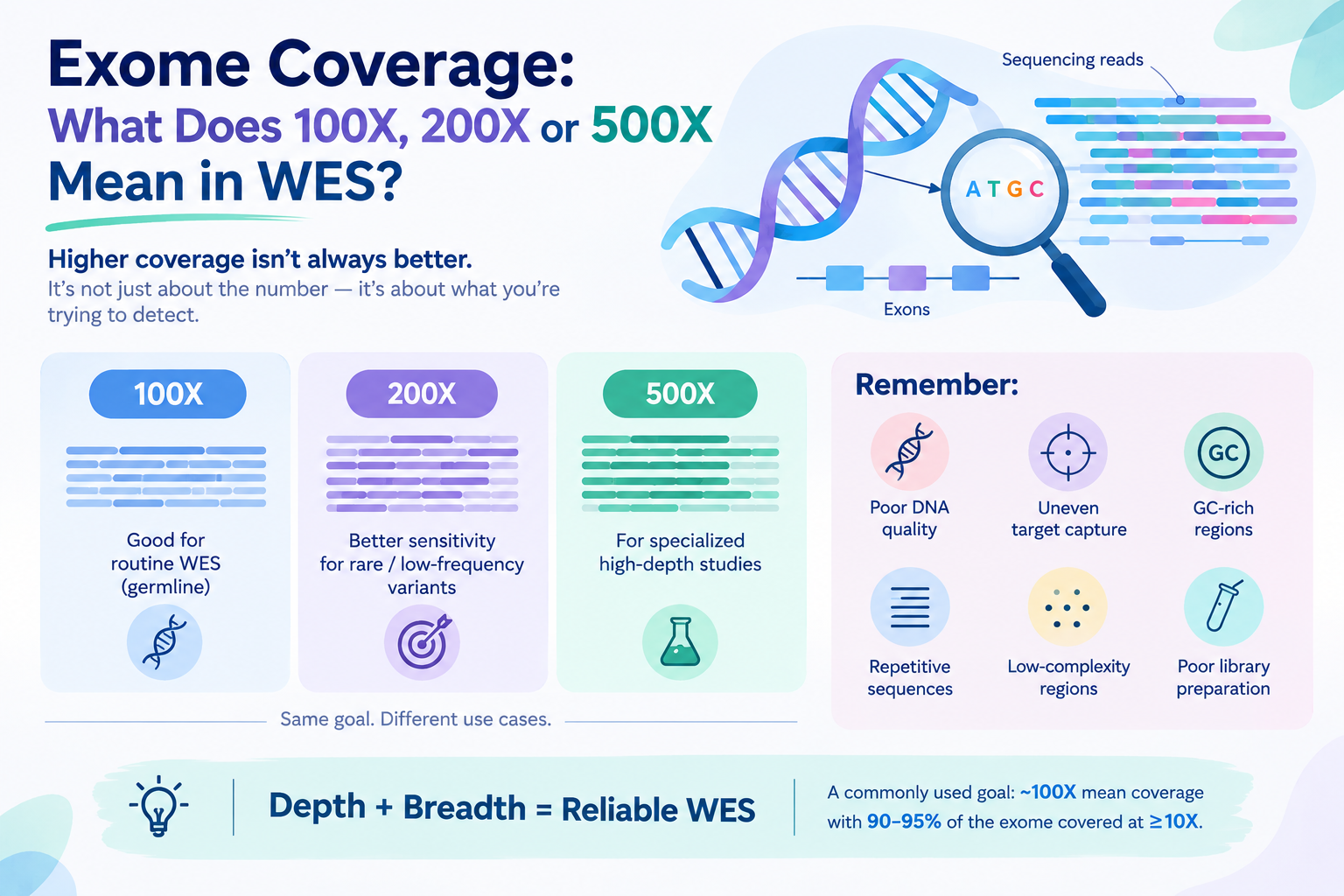
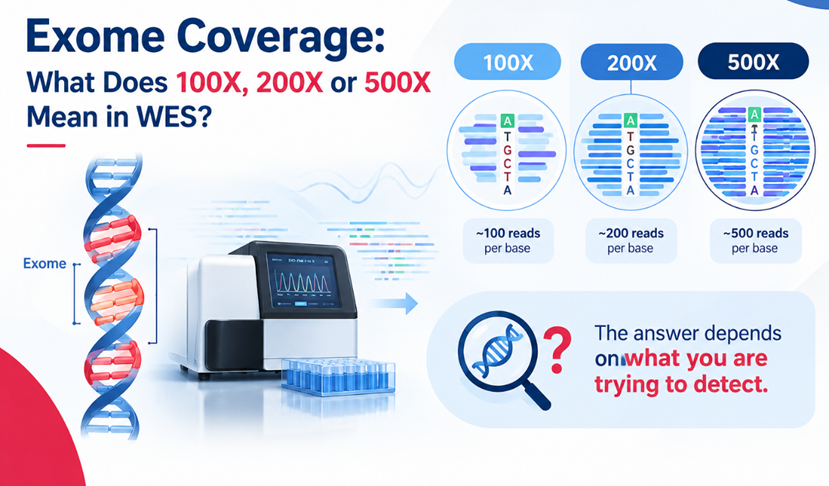
In Whole Exome Sequencing (WES), you’ll often see terms like 100X, 200X, or 500X coverage. But what do these numbers actually mean and does higher coverage always mean better sequencing? The answer depends on what you are trying to detect.
What Does “100X Coverage” Mean?
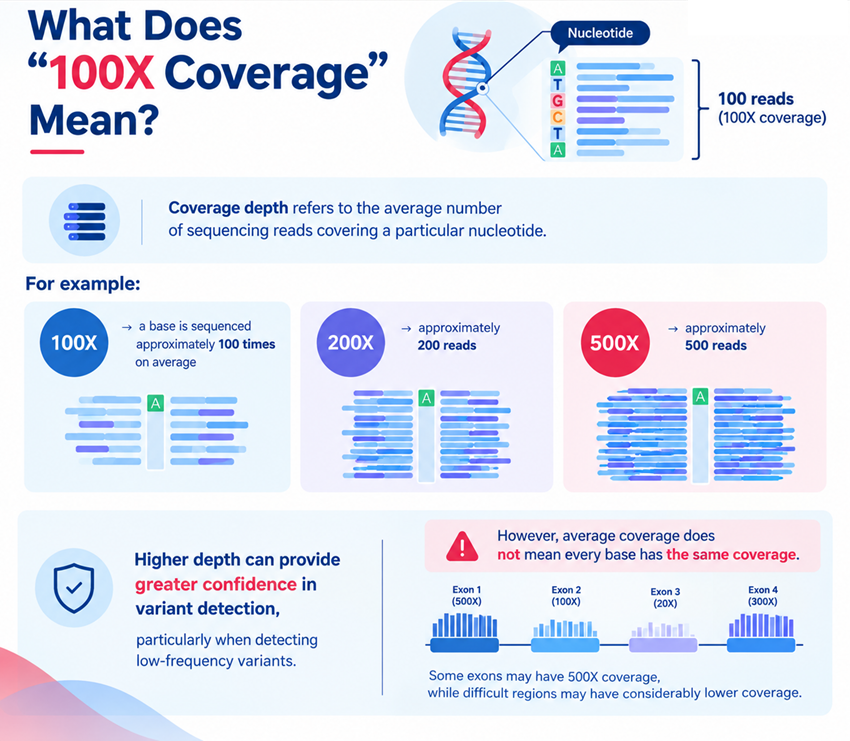
Coverage depth refers to the average number of sequencing reads covering a particular nucleotide. For example:
- 100X → a base is sequenced approximately 100 times on average
- 200X → approximately 200 reads
- 500X → approximately 500 reads
Higher depth can provide greater confidence in variant detection, particularly when detecting low-frequency variants. However, average coverage does not mean every base has the same coverage.
Some exons may have 500X coverage, while difficult regions may have considerably lower coverage.
100X vs 200X vs 500X WES
| Coverage | Typical Use | Key Advantage |
| 100X | Germline variant analysis | Strong coverage for routine WES |
| 200X | Rare/somatic variant research | Improved sensitivity for low-frequency variants |
| 500X | Specialized high-depth studies | Higher sensitivity for very low-frequency variants |
For many germline WES applications, around 100X mean coverage with a high proportion of target bases achieving adequate depth is commonly used. Importantly, coverage breadth such as the percentage of exome bases reaching ≥20X can be more informative than mean depth alone.
Is 500X Always Better?
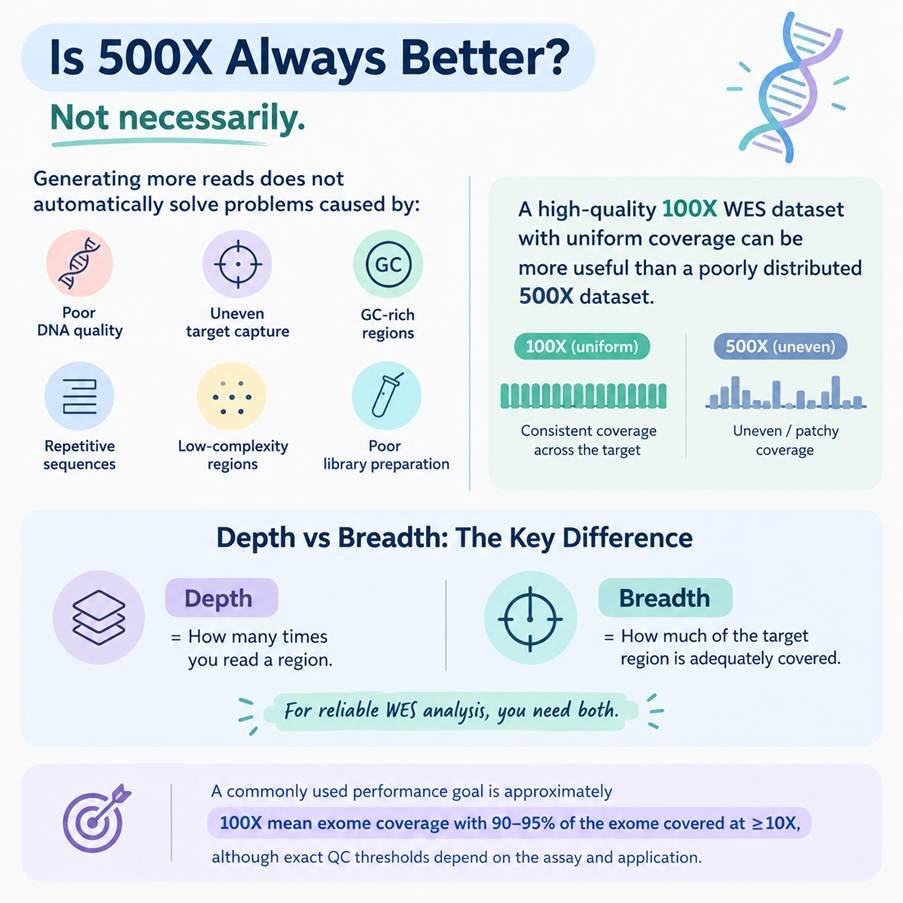
Not necessarily.
Generating more reads does not automatically solve problems caused by:
- Poor DNA quality
- Uneven target capture
- GC-rich regions
- Repetitive sequences
- Low-complexity regions
- Poor library preparation
A high-quality 100X WES dataset with uniform coverage can be more useful than a poorly distributed 500X dataset.
Depth vs Breadth: The Key Difference
Think of it this way:
Depth = How many times you read a region.
Breadth = How much of the target region is adequately covered.
For reliable WES analysis, you need both.
A commonly used performance goal is approximately 100X mean exome coverage with 90–95% of the exome covered at ≥10X, although exact QC thresholds depend on the assay and application.
Which Coverage Should You Choose?
The ideal WES depth depends on your research question:
🧬 Germline / inherited variants → ~100X
🔬 Rare or low-frequency variant research → ≥200X may be appropriate
🧪 Specialized high-depth studies → 500X or more may be considered
There is no single “best” coverage for every WES project.
The Bottom Line
100X, 200X and 500X are not simply quality scores—they represent sequencing depth.
The right WES strategy should balance coverage depth, coverage uniformity, target breadth, sequencing quality and the biological question.
Need reliable WES sequencing with comprehensive coverage and downstream variant calling & annotation?
Partner with CellSeq Solutions LLP for WES and NGS services tailored to your research requirements.